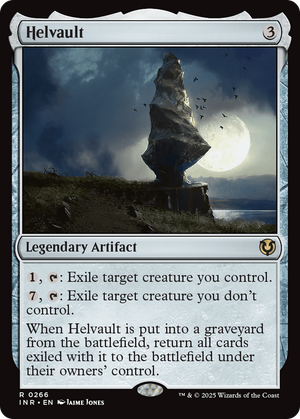
Helvault

A prison that promises its own jailbreak. The cheap mode locks away your own creatures for a single mana, banking them; the seven-mana mode reaches across the table to imprison a threat you cannot otherwise answer. What ties both halves together is the death trigger: when Helvault hits the graveyard from the battlefield, everything it has swallowed comes pouring back at once, your stored creatures alongside whatever you exiled, all of it returning to its owners. That clause is the whole strategic axis. As removal it is conditional in the worst way, since the artifact itself stays on the battlefield as a target, and any opponent willing to crack it gets their creature back. As a storage engine, it rewards a deck built to destroy its own Helvault on cue, dumping a stockpiled board all at once. The design lives in the tension between the player who built around the release and the player forced to trigger it accidentally, and the timing matters: the release fires only on a trip to the graveyard, so an exile or bounce effect aimed at Helvault permanently strands everything inside it rather than freeing it. This is flavor-forward design where the rules genuinely model the story, a vault that holds horrors only as long as it stands intact, and the steep tax on the second ability stops it from doubling as a clean exile spell. Few artifacts make their own destruction the most interesting line of play; this one builds an entire decision tree around when, and by whom, it gets cracked open.
Rules text
 ,
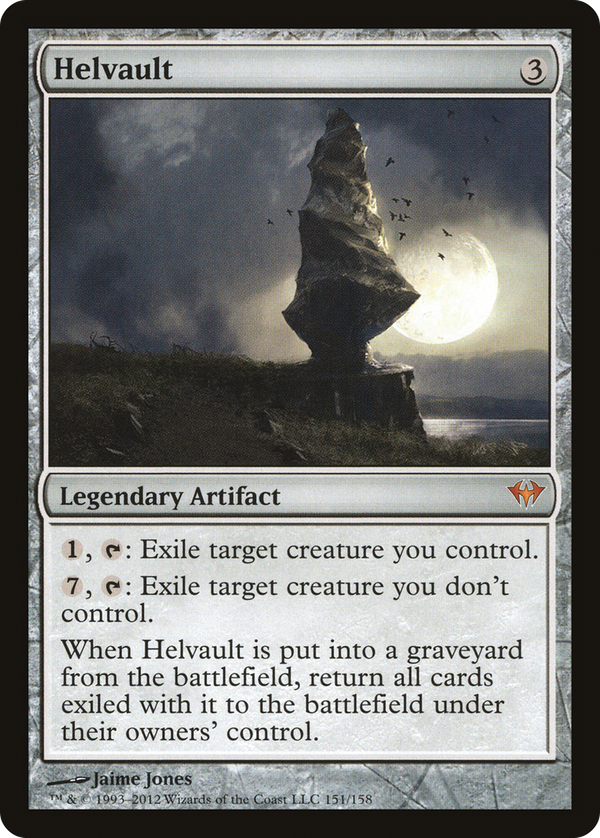
,  : Exile target creature you control.
 , : Exile target creature you don't control.
When Helvault is put into a graveyard from the battlefield, return all cards exiled with it to the battlefield under their owners' control.
, : Exile target creature you don't control.
When Helvault is put into a graveyard from the battlefield, return all cards exiled with it to the battlefield under their owners' control.