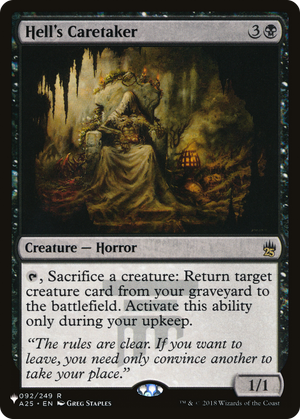
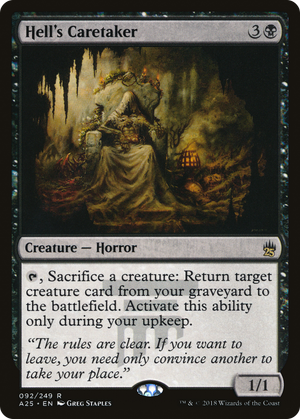
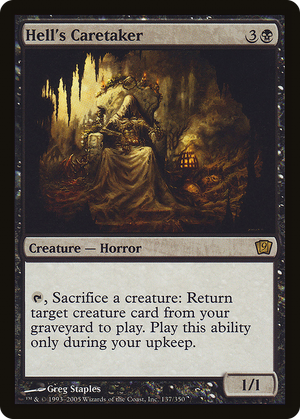
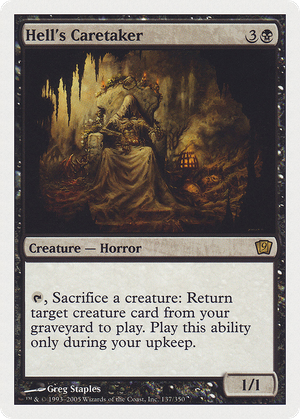
Hell's Caretaker


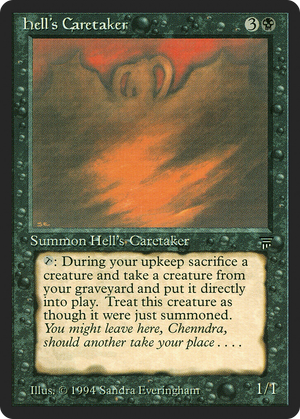
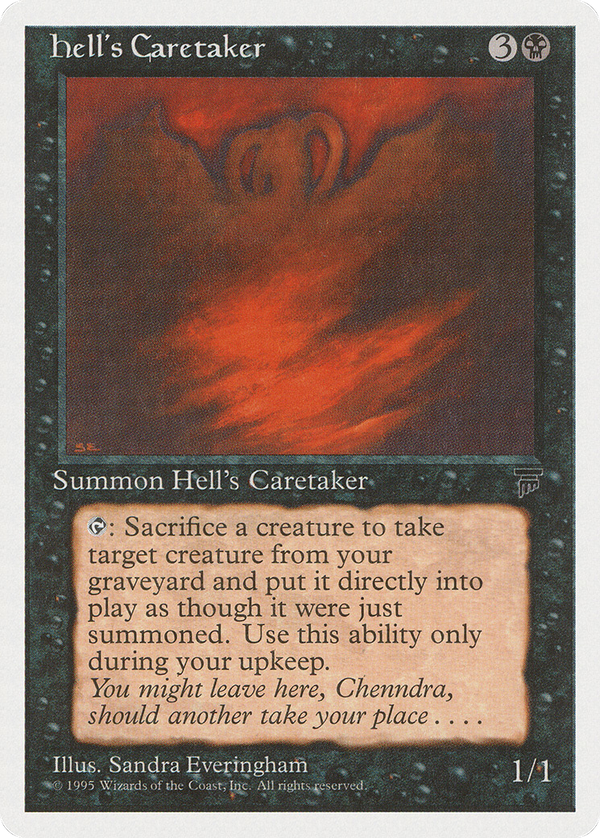
Reanimation as a repeatable engine, printed in 1994 with all the friction the era thought necessary to keep it honest. The upkeep restriction is the load-bearing constraint: you must survive a full rotation to fire it, which means the opponent gets a draw step and a main phase to find an answer before the loop closes. The sacrifice cost doubles as the fuel, turning every creature you cast into a future trade-up, and the tap symbol means a Diabolic Edict or a single point of damage to the 1/1 body shuts the engine off. Compare what reanimation looked like two years later, when Animate Dead and Necromancy offered the same effect for two mana on the stack and Reanimate offered it for one: the Caretaker is the slow, grinding version of an effect the format would soon learn to do at instant speed for a fraction of the mana. What survives is the design template. A repeatable graveyard-to-battlefield engine stapled to a fragile body, gated by a timing window and a sacrifice cost, is the shape Wizards has returned to across decades: Doomed Necromancer, Sheoldred (the original), Whisper, Blood Speaker, on down the line. Hell's Caretaker is the first sketch of an archetype the game has been refining ever since, and the upkeep clause is the fingerprint that dates it.
Rules text
 , Sacrifice a creature: Return target creature card from your graveyard to the battlefield. Activate only during your upkeep.