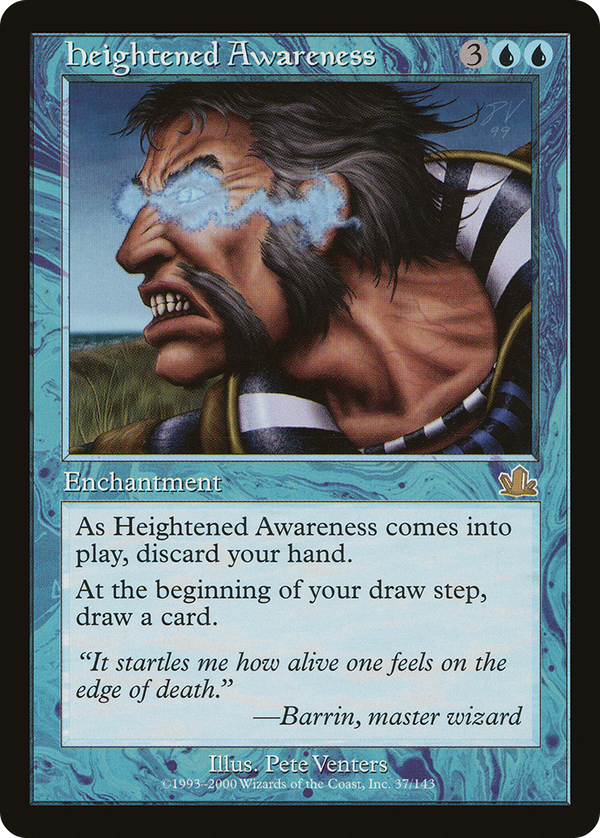
Heightened Awareness


The cost is paid up front and in full: empty your hand the instant it resolves, then collect interest from your draw step forever after. That structure makes this a tempo gamble dressed as card advantage, because the discard is not a drawback bolted onto a value engine; it is the entire balancing mechanism. You trade every card you currently hold for a permanent that only refunds the investment if it survives long enough to draw back what you tossed, and only profits past that. The friction sits in the timing. At five mana and sorcery speed, you commit the whole hand on a turn when you are tapped out and least able to defend the enchantment that justified the sacrifice. This is among the starkest examples of an early-era fascination with lopsided resource conversions, the trade of something you have for something you might get: it refuses to do anything the turn it lands, and only begins to function on a clock an opponent can interrupt by killing the enchantment or simply ending the game first. The card's real identity is that wager, the bet that a deck can afford to bottom out at zero cards in hand on the promise of an extra draw each turn, and how many turns of survival it takes before the compounding math finally surfaces above water.