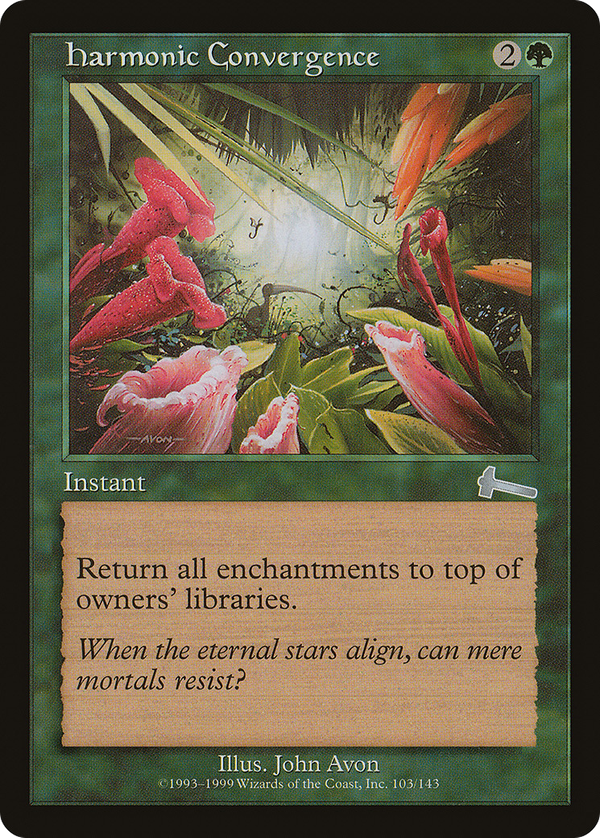
Harmonic Convergence


Most enchantment removal of its era destroyed: blew up the permanent, sent it to the graveyard, ended the conversation. This one bounces, and the choice to put everything on top of libraries instead of into hands is the whole design. The owner does not get to replay the enchantment for free; they redraw it next turn, costing them a card-draw step and the mana to recast. That tempo tax is what separates Harmonic Convergence from a clean answer: against an enchantment-heavy board it strands one rebuild on top of each affected player's deck per enchantment they owned, buying a full turn while leaving your own enchantments in the same boat. The instant speed matters more than the symmetry suggests, because it lets you wait until an enchantment has resolved and its trigger is on the stack, then reset the board after the opponent has already committed. There is a real catch worth naming: a card on top of the library is exactly what a fetch land's shuffle or a scry can tuck away or dig past, so a deck built to manipulate its own draw can soften the redraw cost. Green has always been the color with the broadest license to wreck artifacts and enchantments at the cost of precision, and this is green's bluntest instrument: a one-sided beating only if you have built around having no enchantments yourself, a wash if you have not. The library-stacking clause is the part worth studying, a deliberate refusal to grant card advantage to either player while still buying breathing room.