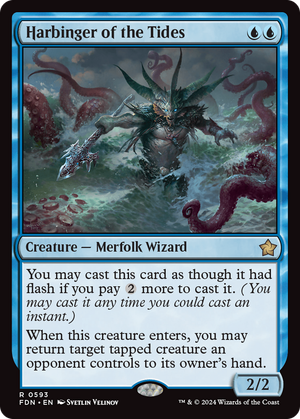
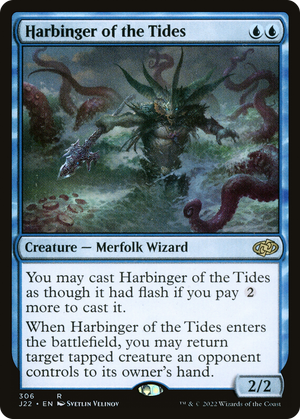
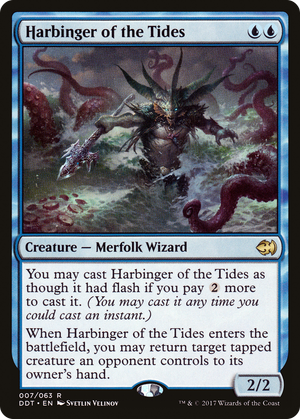
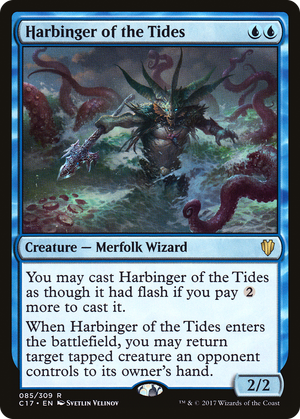
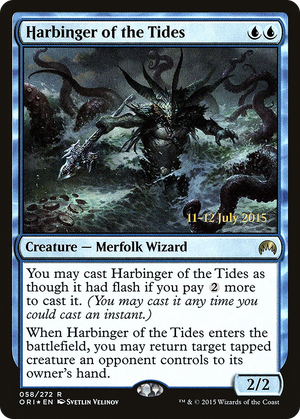
Harbinger of the Tides

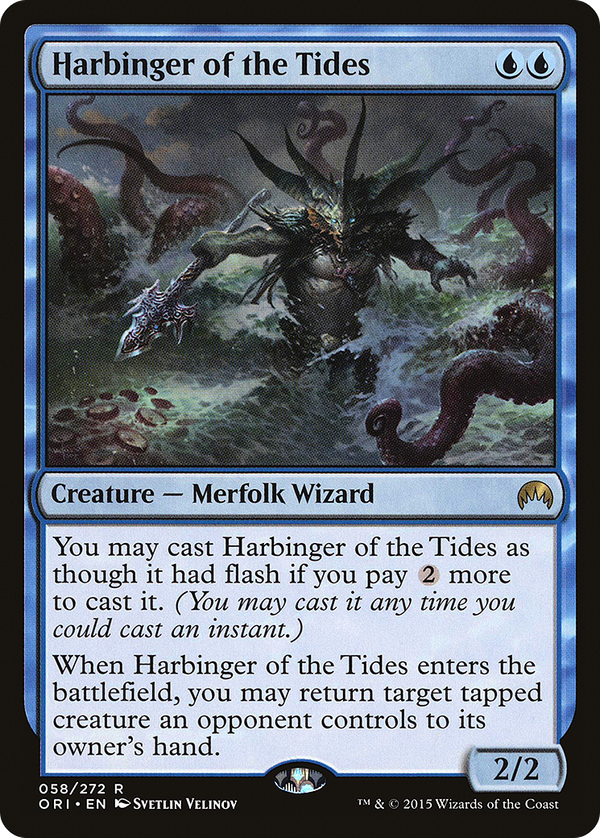
The flash clause is the whole gambit, and it only opens a window because the trigger demands a tapped target. That single word is the discipline: a creature has to have already committed (attacked, or tapped for an ability) before the bounce can answer it. Cast flat for two mana, this is a sorcery-speed play that lands on your own main phase, where the most reliable tapped target is something an opponent left tapped from attacking the turn before, or a mana creature spent on the previous turn. The card earns its keep with the extra cost: pay it and the same trigger arrives at instant speed, so you bounce the attacker after declaration, after the opponent has tapped out and pointed their threat at you, and you keep your own mana untouched until you know what the game asks for. The tension is real. A clean unconditional bounce at instant speed on a 2/2 body would be far too efficient, so the tapped requirement narrows the field to creatures that have already spent their turn, rewarding patience over reflex. Blue tempo decks in the years after this kind of merfolk first appeared valued exactly that flexibility: an empty-turn two-drop that still pressures the board, or a held-up answer that doubles as a clock the following turn. The optional cost is the hinge, letting one card flex between proactive curve-filler and reactive interaction without splitting the deck's plan in two.
Rules text
 more to cast it. (You may cast it any time you could cast an instant.)
When this creature enters, you may return target tapped creature an opponent controls to its owner's hand.
more to cast it. (You may cast it any time you could cast an instant.)
When this creature enters, you may return target tapped creature an opponent controls to its owner's hand.