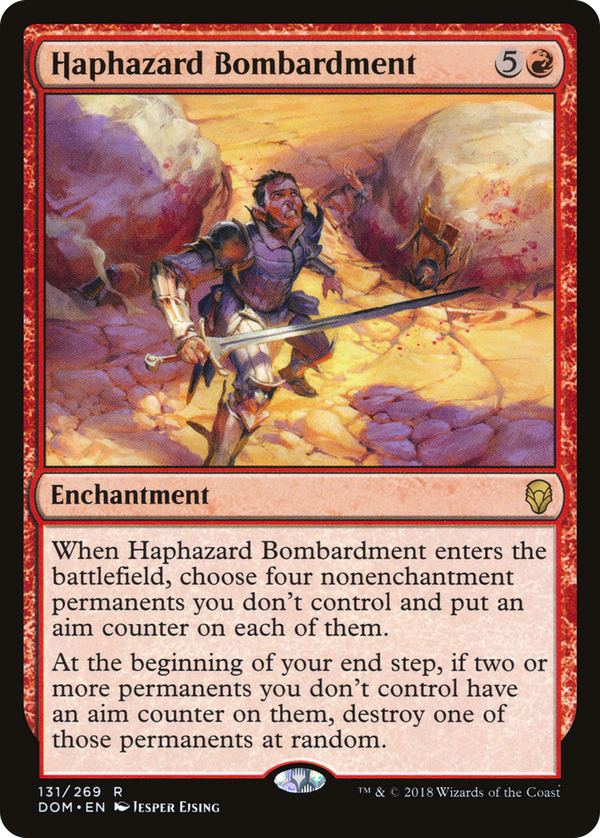
Haphazard Bombardment


The randomness is the whole bargain, and it cuts against you as often as for it. Marking four opposing permanents for destruction, one per turn at random, reads like a slow board-control engine, but the design hands the controller no say in the order: the aim counter that lands on an irrelevant token has the same odds of being the one destroyed as the one on the bomb. The trigger only fires while two or more aim counters remain, which caps the whole affair at three destructions no matter what: once the count drops to a single marked permanent, the engine stalls permanently and that last survivor keeps its counter forever. That gives the targeted player a real lever. Thin the marks below two (sacrifice, bounce, or blink your own way down to one) and the destruction stops entirely. A clever opponent can steer the outcome further by shedding the permanents they were happiest to lose, leaving the random clause to roll dice on whatever they most wanted to keep. So the six-mana price buys a removal effect that destroys up to three things on a timer you cannot set, in an order you cannot choose, with an off-switch your opponent holds. The variance has to be the appeal rather than the cost. The honest read is that this rewards a table that delights in chaos more than a deck that needs its answers to land on purpose, and the random clause is doing precisely what it was built to do.