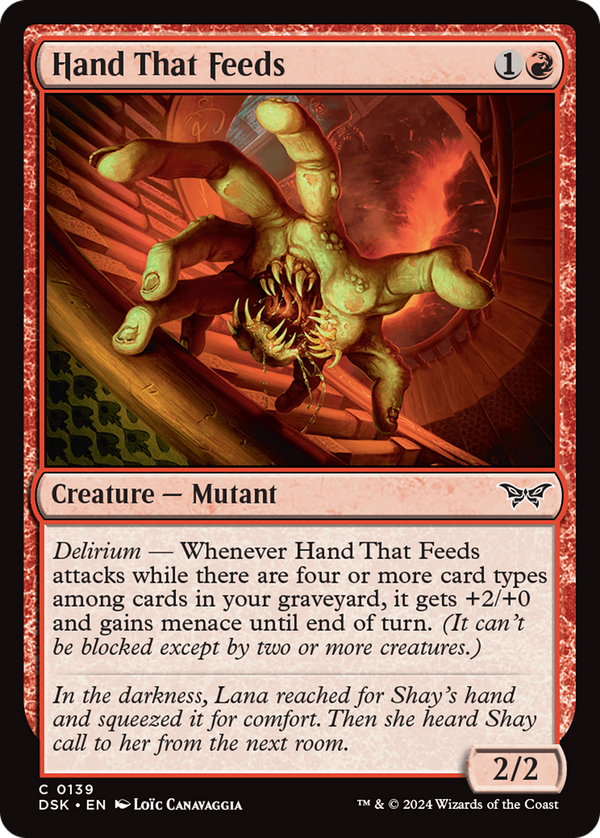
Hand That Feeds


Delirium as a keyword usually attaches to cards that pay off graveyard density with card advantage or reach: an extra draw, a bigger body, a recurring threat. Here the reward is compressed into the attack step and priced onto an aggressive two-drop. A 2/2 for is a fine early curve-filler on its own, but the delirium clause is what defines its role: reach the requisite variety of card types in your graveyard and every swing turns this into a 4/2 that two blockers must gang up to stop. That is the tension the design resolves. Aggressive red decks want cheap bodies that stay relevant into the midgame, but they rarely fill their own graveyards with the variety delirium wants; the card asks a beatdown deck to do a small amount of enabling work (a fetch, a discard, a dead artifact or enchantment) to unlock a threat that both grows and gets harder to profitably block. The menace matters more than the +2/+0 in practice: a 4/2 that trades down is one thing, but forcing two creatures to commit to the block is how a single two-drop's worth of investment breaks a stalled board or protects a wider attack. It is a delirium payoff built for the color that historically struggles to turn the mechanic on, which is exactly why the reward lives on the attack trigger rather than baked into the stat line.