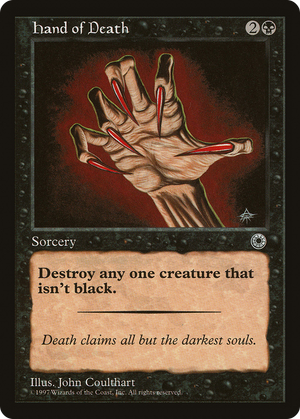
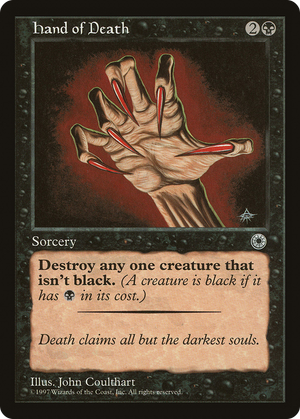
Hand of Death


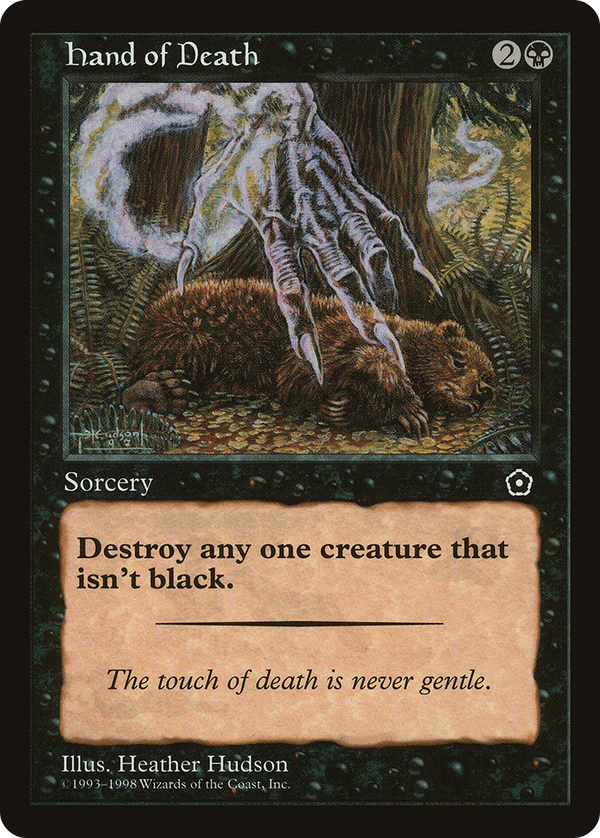
A removal spell pared back until only the essential parts remain. Black gets to kill creatures, but the effect is fenced off from its own color so that a mirror match between two beginners does not dissolve into both players trading kill spells every turn. That nonblack clause is the whole balancing act: remove it and you have an overcosted unconditional removal spell; keep it and the card quietly teaches color identity, the idea that black's reach has limits and those limits are part of how the color is meant to feel. The sorcery shape reinforces the lesson. There is no end-of-turn ambush, no complex timing to misread, just a clean main-phase answer a learning player can sequence without surprises. What earns it a second glance is how plainly the constraint maps to a design philosophy that later sets would express with more finesse. Plenty of black removal since has carried the same restriction against killing black creatures, but few wear the reasoning so openly on the card itself. It is a snapshot of Wizards deciding what the simplest version of black removal should look like for an audience that has never read a stack rule.