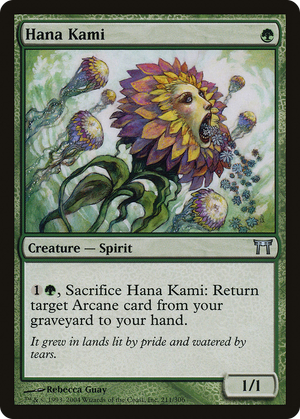
Hana Kami

Recursion is what kept the Arcane subtheme honest, and this is the green half of the engine. The whole spell-based deck of its era ran on cantripping splice cards: Glacial Ray, Desperate Ritual, the cheap Arcane spells you wanted to cast again and again. A 1/1 that recovers any of them from the graveyard for two mana turns those one-shots into a renewable resource, and because the recursion costs a sacrifice, it converts a body you were not going to swing with into card advantage. The natural partner is Soulshift, a keyword that returns a small Spirit to hand when another Spirit dies. The loop works only if you read the timing correctly: Hana Kami has to already be in the graveyard for a Soulshift trigger to target it, so the sequence is sacrifice Hana Kami first (paying its own activated cost to buy back a spell), then let a Soulshift creature die afterward to fetch the Spirit back. That feedback structure (a Spirit that buys back Arcane, a graveyard mechanic that buys back the Spirit) is the kind of closed engine the block was built around, and it explains why such a modest creature mattered: it was never meant to attack, it was meant to keep the spellbook open. Outside an Arcane-dense graveyard it does nothing, which is exactly the constraint that prices the effect: the targeting clause locks it to a card type that only ever existed in one design space.
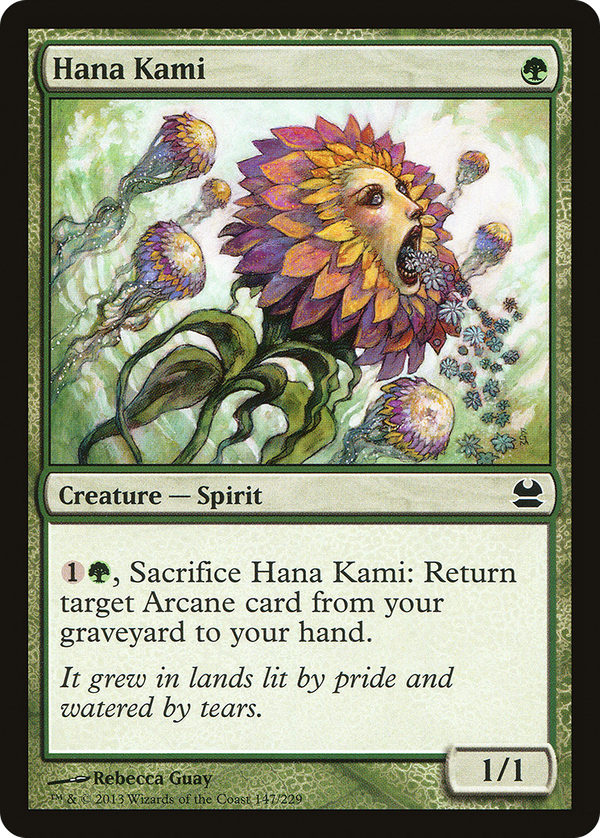
Rules text
 , Sacrifice this creature: Return target Arcane card from your graveyard to your hand.