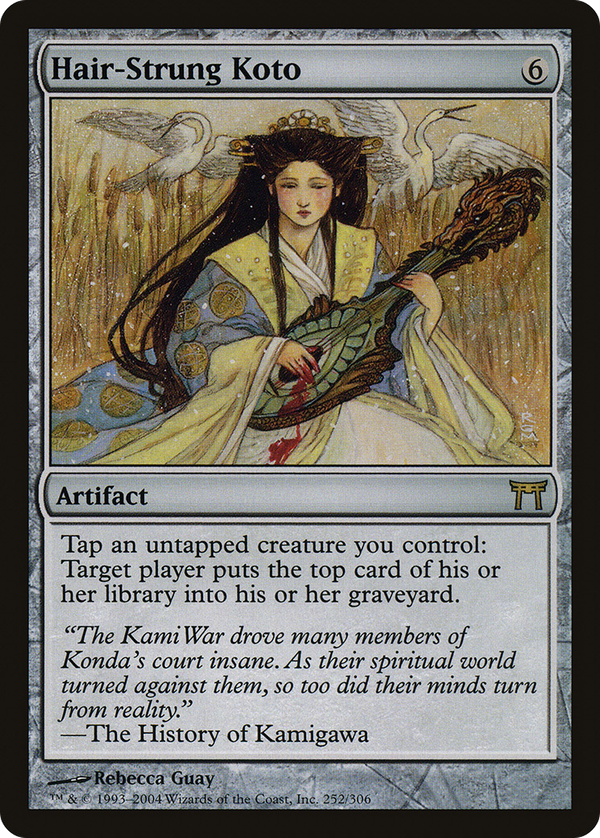
Hair-Strung Koto

Mill priced as a hobby project rather than a clock. The math is brutal: each activation taps one creature to remove a single card from a library, which means a board of five attackers, none of them attacking, grinds out five cards a turn at best. That is the kind of rate that turned early mill from a strategy into a parlor trick. What the design actually wanted was a board of small, expendable bodies whose combat value had already been spent (tokens, leftover attackers, creatures with summoning sickness that can still tap for an ability), repurposed as a slow drain on an opponent's deck. The artifact frame is the tell: it asks for no color commitment, so it sat in any creature-heavy shell willing to wait. But the six-mana cost up front makes it the rare engine that costs a full turn to deploy and then asks for a board of creatures to do anything at all. It is a study in how mill was costed before the mechanic was understood as a real win condition: too expensive to start, too slow to finish, and dependent on a creature count that mill decks of its era almost never had. A flavorful curiosity that documents an era when decking an opponent was treated as a novelty rather than a plan.