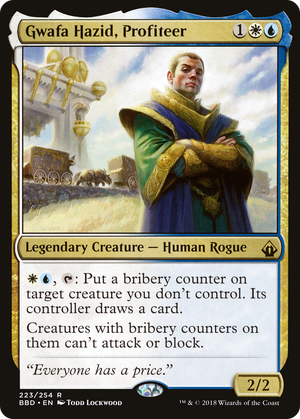
Gwafa Hazid, Profiteer



A pacifism effect that pays its victim, which sounds like a contradiction until you watch it run. The shutdown lives on the body, not on the counter: tap, spend , and a creature you don't control gets a bribery counter while its controller draws a card, but the attack and block restriction is a static ability emanating from this 2/2. Remove it from the battlefield and every counter becomes inert decoration, with the disabled creatures free to swing again the moment it dies. That fragility is the whole strategic axis. You are not buying a permanent lockdown; you are buying a peace that lasts exactly as long as you can keep a 2/2 alive, and every activation hands an opponent a fresh card to find the removal that breaks it. In a one-on-one fight that exchange bleeds you over time, which is why this was never built as a control engine. It is a multiplayer political instrument, a creature whose ability is leverage rather than a clean answer. The card-draw clause turns an oppressive tax into a deal the table can see and price: neutralize whoever is ahead, let them refill, keep the rest quiet about whose turn comes next. The design treats disruption as a bargaining chip, attaching a cost that gives resources back instead of simply taking options away, an early-era experiment in making removal something opponents could be paid to tolerate.
Rules text
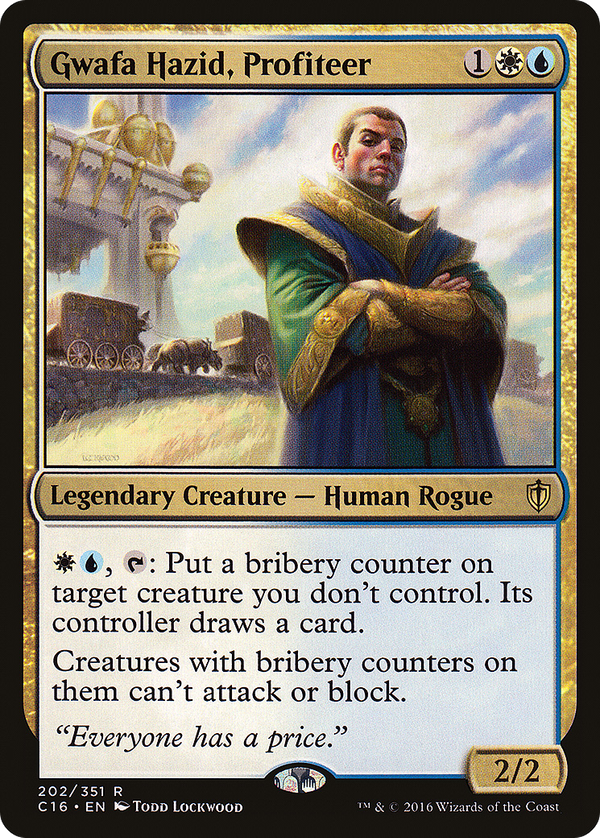
,  : Put a bribery counter on target creature you don't control. Its controller draws a card.
Creatures with bribery counters on them can't attack or block.
: Put a bribery counter on target creature you don't control. Its controller draws a card.
Creatures with bribery counters on them can't attack or block.