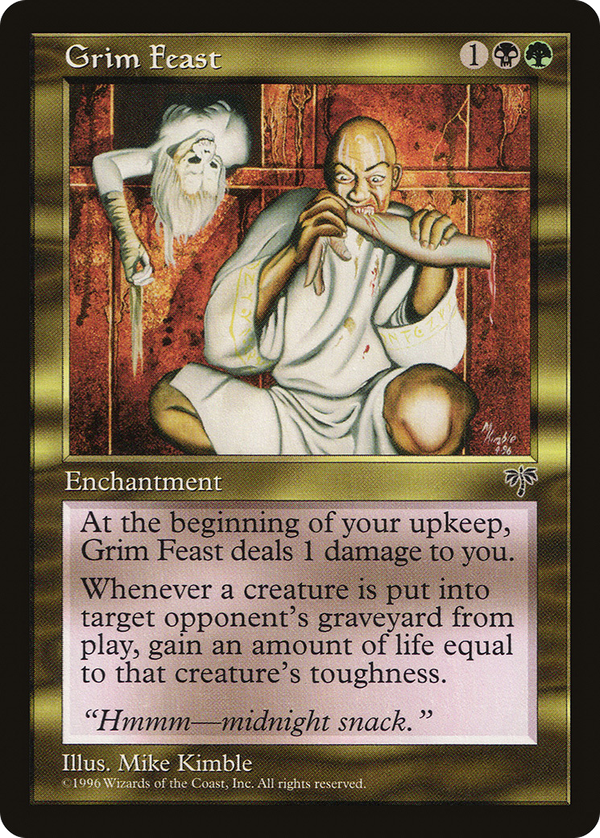
Grim Feast



A lifegain engine built on someone else's body count, which is the design tell that dates it precisely to its era. The trigger only cares about creatures dying on the opponent's side, so the card does no work in a vacuum: it asks you to be the one doing the killing, then pays you back in life equal to whatever you removed. The toughness clause is the clever bit, because it rewards trading up. Picking off a fat blocker returns more life than picking off a token. The self-damage on upkeep is the cost of admission, a slow clock you accept in exchange for the engine, and it speaks to a design philosophy that wanted enchantment-based value to carry a maintenance tax rather than sit free. That tax is also what makes the card feel its age: modern green-black removal-and-drain packages bury their lifegain inside creatures or one-shot spells, where here the payoff lives on a permanent you have to keep feeding. The result is an attrition piece for a grindy removal deck, not a finisher, and it only turns on once you have committed to being the aggressor in the kill column. Outside of a build constructed to weaponize opposing deaths, it is a one-point-per-turn liability that never pays for itself.