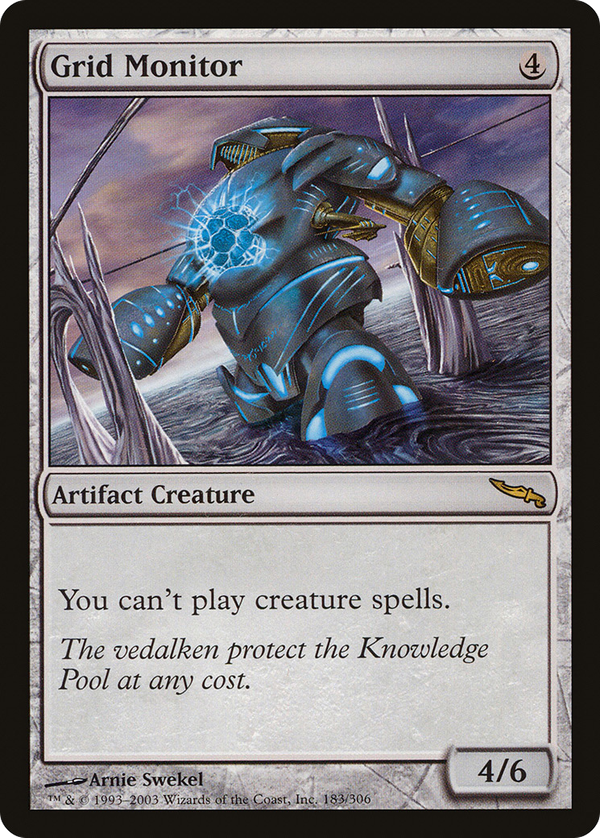
Grid Monitor

The drawback is the whole concept: a 4/6 body, oversized and durable for its cost, sold at the price of locking you out of every other creature you might field. That trade points the card at exactly one kind of deck, the kind that wins without bodies at all: artifact-prison shells, control builds whose only threat is a single hard-to-kill blocker, or combo lists that run no creatures by design and lose nothing by signing the contract. The restriction stings because of how total it is: not a tax, not a delay, but a flat prohibition that turns every creature already in your library into a dead draw the moment this resolves. It traces back to an early-era school of artifact design that asked you to surrender a deckbuilding axis for stats, the same bargain logic behind cards that demand you skip a phase or give up a card type entirely. A 4/6 blocks nearly everything that attacks on the ground and shrugs off most burn aimed at it, so the body genuinely earns its keep as a wall. The question the card poses is whether any deck wants a wall badly enough to swear off the creature slot wholesale, and the answer has almost always been no. That gap between an attractive statline and a self-defeating cost is the card's entire identity: a creature built to be played by decks that have already decided they cast none.