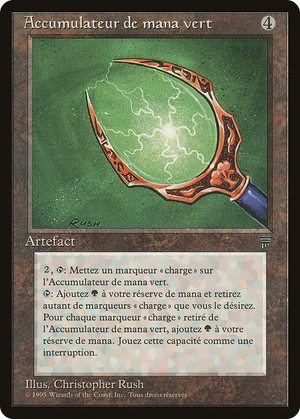
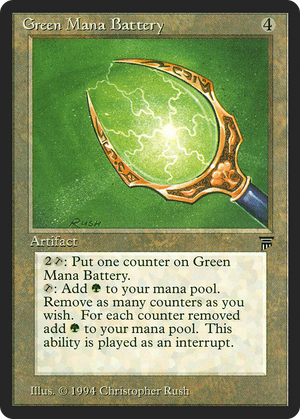
Green Mana Battery

Two mana in, two mana out, and only if you wait a turn to spend it: this is a converter with a deliberately punishing exchange rate, and it is one of the cleanest illustrations of the problem ramp has always wrestled with. How do you store mana across turns without breaking the symmetry that makes resource development interesting? The charge counter is the accounting trick that makes the design legible: each counter is a turn you chose not to cast a spell, banked against a future turn when you want to cast something larger. Green's version is the one whose math comes closest to working, because green already produces mana on creatures and lands and therefore has the easiest time feeding the battery without falling behind on board. The same charge-counter vocabulary surfaces again decades later in Astral Cornucopia and Everflowing Chalice, both of which load and unload on far better terms. The rate is what relegates it to history: four mana down and two mana per counter is a tax the modern game stopped charging long ago, once Wizards learned that storage effects need to be either cheaper to load or more explosive to unload. As a design specimen it still reads cleanly; as a card you would actually cast, the exchange rate has nothing left to offer.
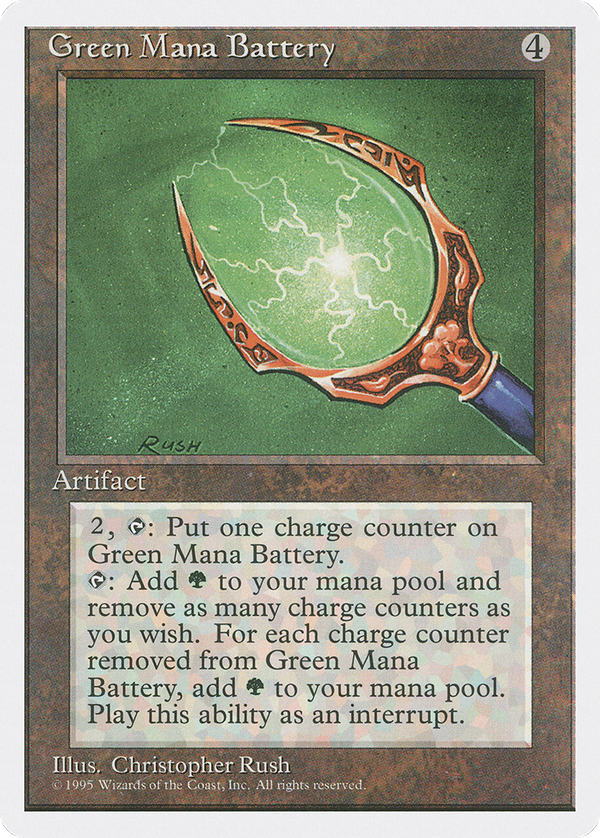
Rules text
 ,
,  : Put a charge counter on this artifact.
, Remove any number of charge counters from this artifact: Add
: Put a charge counter on this artifact.
, Remove any number of charge counters from this artifact: Add  , then add an additional for each charge counter removed this way.