Great Hall of Starnheim
Producing black is only ever the day job. It enters tapped and taps for a single color, so its baseline is a plain tapland: patient by construction, worth running only for the mode it unlocks later. That second ability is unusually literal in what it demands: three colored pips, the tap, and the sacrifice of both this land and one of your creatures, all at sorcery speed, to assemble a 4/4 white Angel Warrior with flying and vigilance. Because the land itself is the fuel, it can never fire the turn it comes down, and the trade is not one a creature deck wants to make at parity: a body plus a permanent for a body. The math only works once the land has stopped mattering as mana, so the ability is built for the deep grind, when a fifth or sixth source is dead weight and a creature has outlived its usefulness. What it converts them into is an evasive, hard-to-race threat that costs nothing from hand. This belongs to the small line of lands that bury a late-game payoff inside a mana slot, letting a deck cut a finisher without losing one. The color split does quiet signaling work too: it taps for black but pays off in white, pointing at the two-color pairing it was built to serve without asking for a splash. A land with no early game by design, relevant only after the game has dragged past the point where extra mana would be dead anyway.
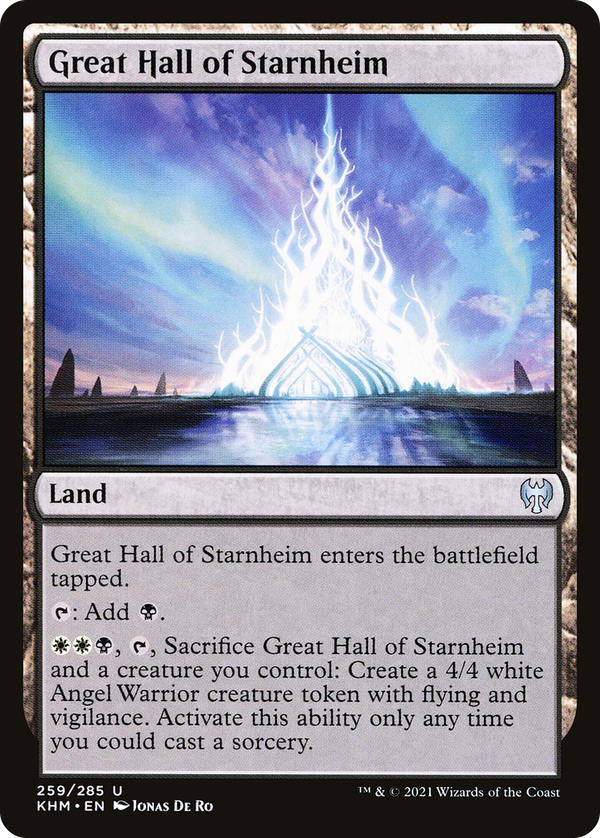
Rules text
 : Add
: Add  .
.
 , , Sacrifice this land and a creature you control: Create a 4/4 white Angel Warrior creature token with flying and vigilance. Activate only as a sorcery.