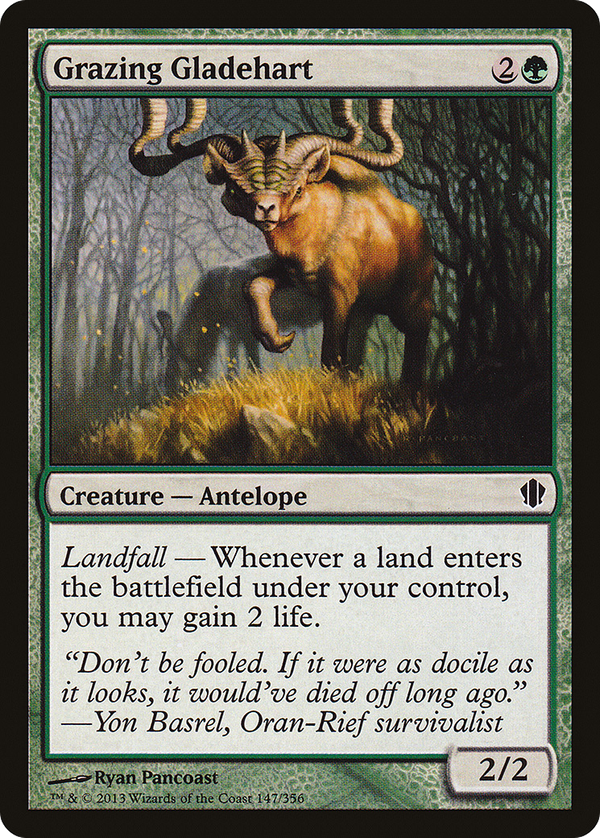
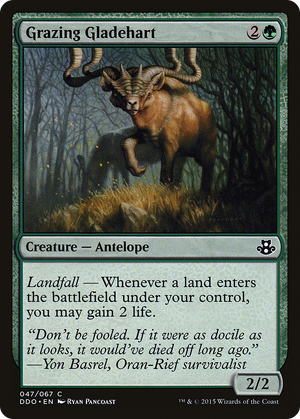
Grazing Gladehart


The design hinges on a multiplier that many early landfall payoffs left implicit: the trigger fires on every land, not just the first one each turn, so the life gained scales with how many lands you can chain into play in a single turn rather than ticking up one drop at a time. A passive lifegain creature gives you a flat number; this body rewards velocity. Crack a fetchland for an additional drop, ramp two or three lands at once, replay lands from the graveyard, and the antelope becomes a payoff engine instead of a 2/2 with a rider. The "you may" wording carries real weight against an opponent who wants to manipulate your life total: facing a Punishing Fire loop or a deck that profits from your life going up, you can simply decline. As an early member of the landfall family, it sketched out the template that later payoffs inherit (the ones that ping, draw, or make a token per land): reward the act of playing a land, not the land itself, and let the deck supply the tempo. The life it returns is rarely a win condition by itself; it is the buffer that keeps a slower, land-heavy plan alive long enough for the rest of the engine to come online.