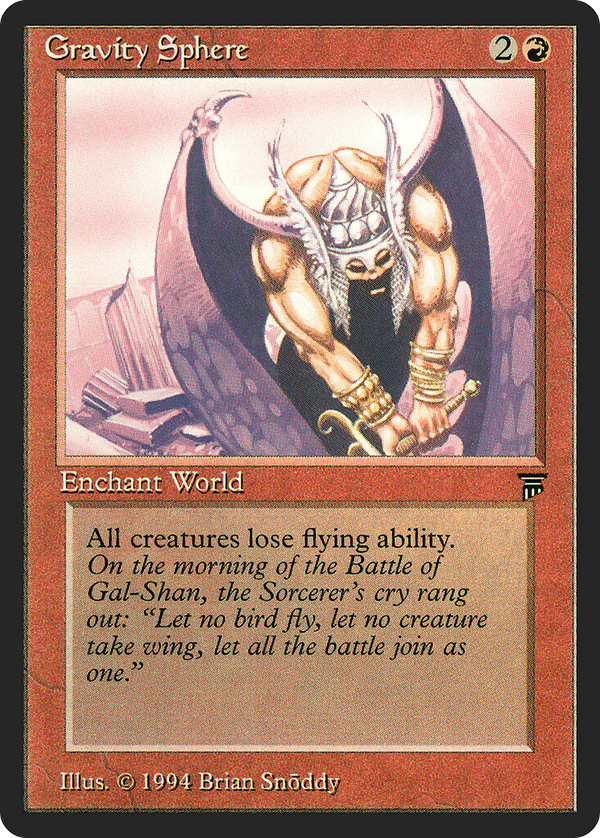
Gravity Sphere


One line of text quietly deletes the most contested axis in the game's first decade: the sky. Every flier, on both sides, becomes a grounded body, which means red gets to legislate away the one combat dimension it was historically built to lose. That is the design provocation here, brute and unconditional. Where Hurricane and the era's anti-flying hosers are reactive removal you cast at fliers already on the table, this is a passive rule change that punishes deckbuilding decisions made before the game began. It earns its sweep through the world-enchantment chassis Legends used to bound exactly this kind of global lever: the world rule permits only a single such permanent in play, so any opponent's world permanent (including a second Gravity Sphere) knocks it off the battlefield. The fuse is that very rule. Two players resolving competing spheres into a permanent grounding war was precisely the chaos the world mechanic existed to police. The text reads as elegant by modern standards because templating has since caught up to its one-line clarity, but in 1994 a global that rewrote combat for everyone, indefinitely, was the kind of thing the format was actively trying to fence in. The card endures as a footnote rather than a fixture, yet the question it poses (what happens when red is allowed to wave the air war away entirely?) is one Wizards has spent thirty years answering with narrower, more conditional tools.