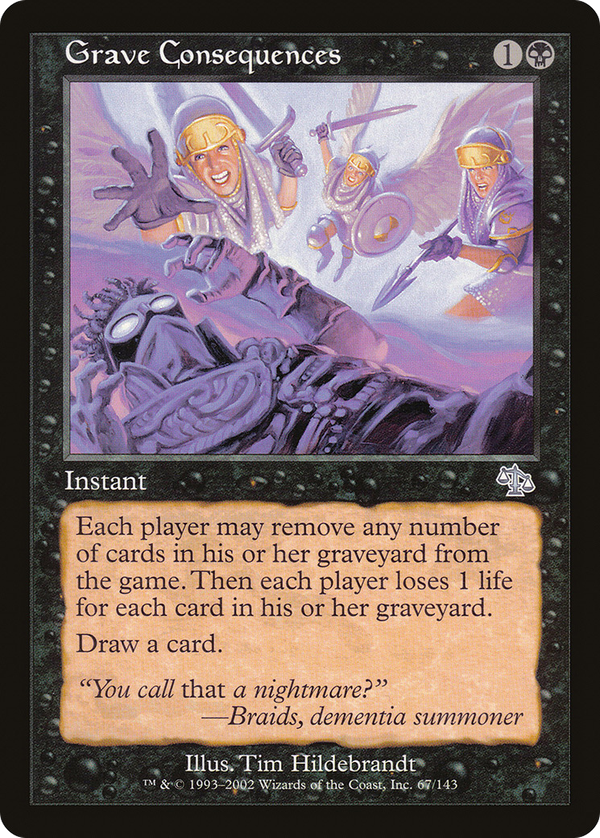
Grave Consequences


Graveyard hate dressed up to look symmetrical, this is anti-recursion tech aimed at the reanimator and threshold strategies that thrived in its era. The trick is in who pays: everyone may exile any number of cards from their graveyard, but the life loss counts what remains after that choice. A clean deck empties its yard and shrugs; a deck whose graveyard is its engine cannot, because exiling its fuel is the same as conceding the loop. So the "may" is the whole mechanism. It lets the caster wipe their own yard to zero while leaving the opponent the dilemma of bleeding life or surrendering their stocked graveyard, and the card replaces itself either way. That cantrip is the detail that elevates it past pure hate: casting it is never card disadvantage, so it answers a graveyard without the dead-draw downside that usually defines a narrow piece of disruption. The cost is that its bite scales entirely with the opponent's graveyard size, which makes it a precision instrument rather than a generically good answer. Against a strategy that wants twenty cards in the yard, it is a real clock that also strips the loop; against anyone else, it is a slightly awkward two-mana cantrip that does nothing the caster wanted. It belongs to a thin tradition of graveyard hate that bothered to read itself, that asked who actually pays the price the symmetry pretends to share.