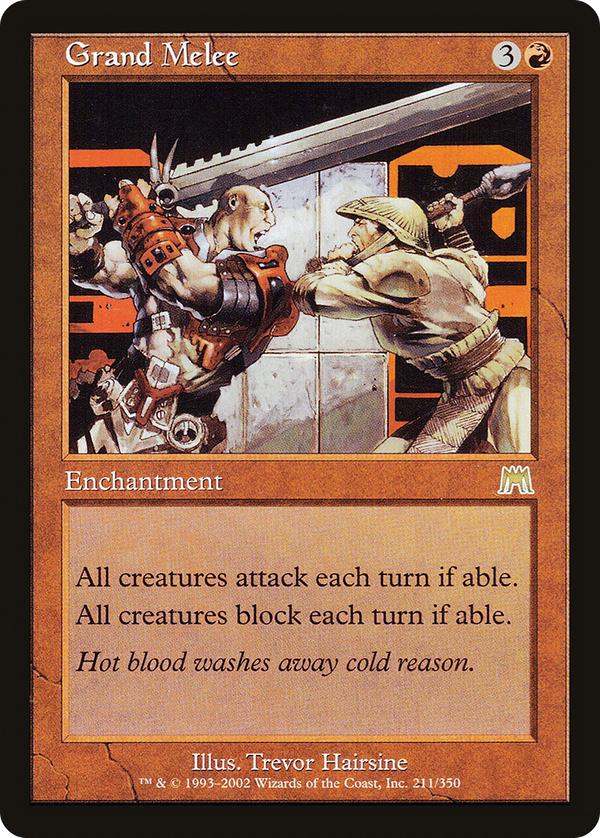
Grand Melee


Forced attacks and forced blocks are old design tools, but welding both onto a single global enchantment turns combat from a decision into a mechanism. The board stops being something you maneuver and becomes something that grinds itself down: every creature charges in, every creature is obligated to throw itself in front of an attacker, and the combat math collapses toward pure trades. What keeps the symmetry from being truly symmetric is the one choice it leaves intact. The defending player still decides how to assign blockers among the attackers; they simply cannot decline to block at all. That single removed option (the ability to hold creatures back) is where the edge lives. Whoever has the bigger bodies, the wider board, or the right combat keywords dictates how the forced exchanges resolve, because the opponent must commit blockers even into matchups they would never volunteer for. It rewards a board where mandatory combat favors you: deathtouch attackers that trade up, evasive threats that cannot be profitably chumped, or a creature large enough that forced blockers die for nothing. The flip side is denial: stripping an opponent of the ability to keep blockers home or alpha-strike on their own terms can be worth as much as the offensive upside. This is chaos used as a control tool rather than a coin flip; it does not randomize outcomes, it deletes the agency a careful defender relies on. The honest limit is that it reads as a multiplayer novelty more than a competitive piece, built for tables that want combat loud and total rather than precise.