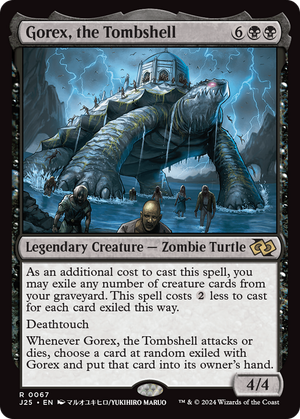
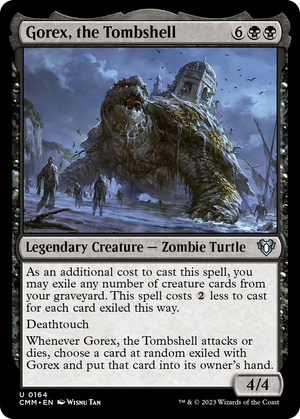
Gorex, the Tombshell


The graveyard is both fuel and payment here, and the tension between those two roles is the whole design. The printed cost is eight, but every creature card exiled from your yard shaves it, so a well-stocked graveyard turns this into a genuine mid-game play rather than a top-end you never reach. That discount is not free value: the cards you exile to cheapen the cast are the same cards you are hoping to claw back one at a time. Each attack or death pulls one exiled card at random into hand, so the more you feed it to reduce the cost, the thinner your odds of hitting the specific card you wanted on any given trigger. Deathtouch on a 4/4 keeps it swinging into unfavorable boards, which matters because attacking is one of only two ways to fire the recursion, and the die-trigger means a removal spell aimed at it still leaves you a card ahead. The randomness is the balancing mechanism a deterministic tutor-back would never carry: a reanimator engine that returns whatever you buried would be oppressive, so instead you get a slot machine you loaded yourself, where deck construction (how many creatures you commit, how redundant they are) sets the payout curve. It is a self-mill and aristocrats payoff dressed as a commander, rewarding a graveyard built wide rather than deep.
Rules text
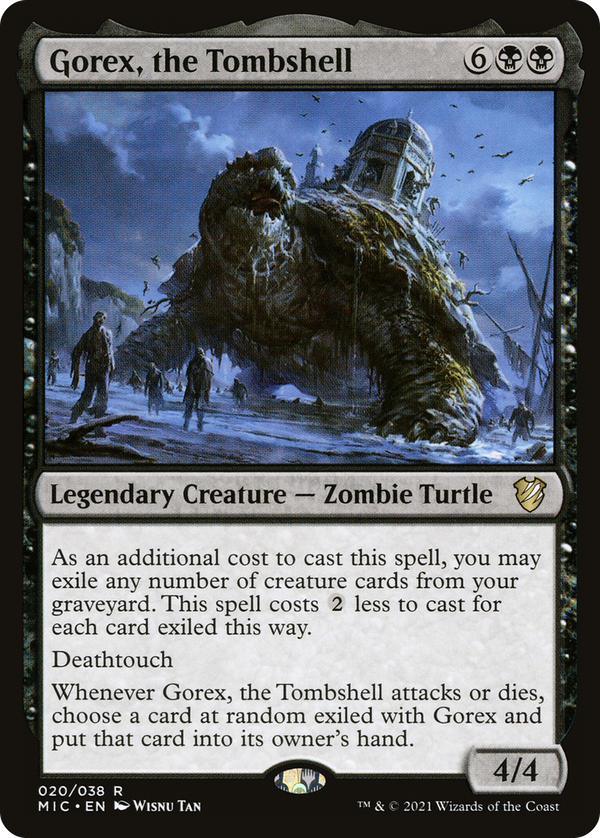
 less to cast for each card exiled this way.
Deathtouch
Whenever Gorex attacks or dies, choose a card at random exiled with Gorex and put that card into its owner's hand.
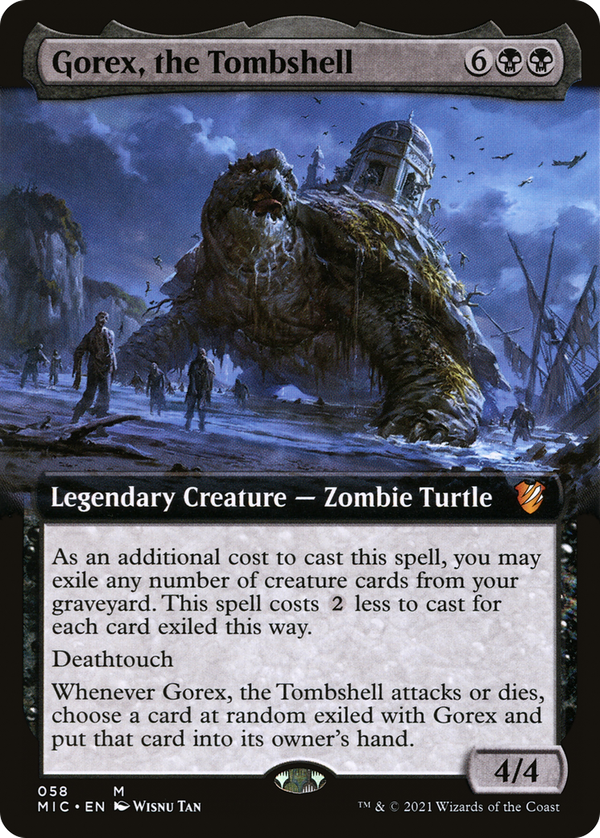
less to cast for each card exiled this way.
Deathtouch
Whenever Gorex attacks or dies, choose a card at random exiled with Gorex and put that card into its owner's hand.