Golden Urn

The economics here are deliberately brutal. To gain any meaningful life, you have to leave the urn untouched across several upkeeps, watching counters accumulate one at a time, then sacrifice the whole thing for a single payout that scales linearly with how long you were willing to wait. Three upkeeps of patience nets you three life; five upkeeps, five life. The counter is a free upkeep trigger, costing no mana and no main-phase action, so the slowness is not about tempo on those turns; it is about the runway, the sheer number of turns the artifact has to survive on the board before the number is worth cashing. This is incremental-payoff design in its plainest form: a battery that converts time into a lump-sum lifegain, with the sacrifice clause making the reward a one-shot you can never bank twice. The upkeep trigger is optional, which matters only if you would rather freeze the counter count where it is, and the activation carries no timing restriction, so the urn can sit as a reactive cushion you crack in response to a lethal swing. None of that rescues the rate. It sits with the slow noncombat life engines that ask for a runway few decks can spare, and the runway is the whole problem: the longer you protect it, the more it pays, but the games where you need ten life back are rarely the games where you had ten turns to spend earning it.
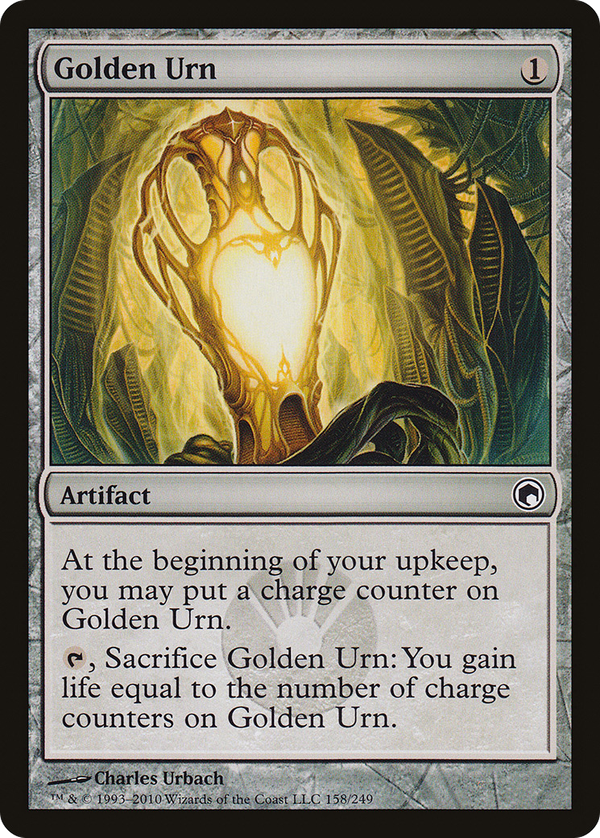
Rules text
 , Sacrifice this artifact: You gain life equal to the number of charge counters on this artifact.