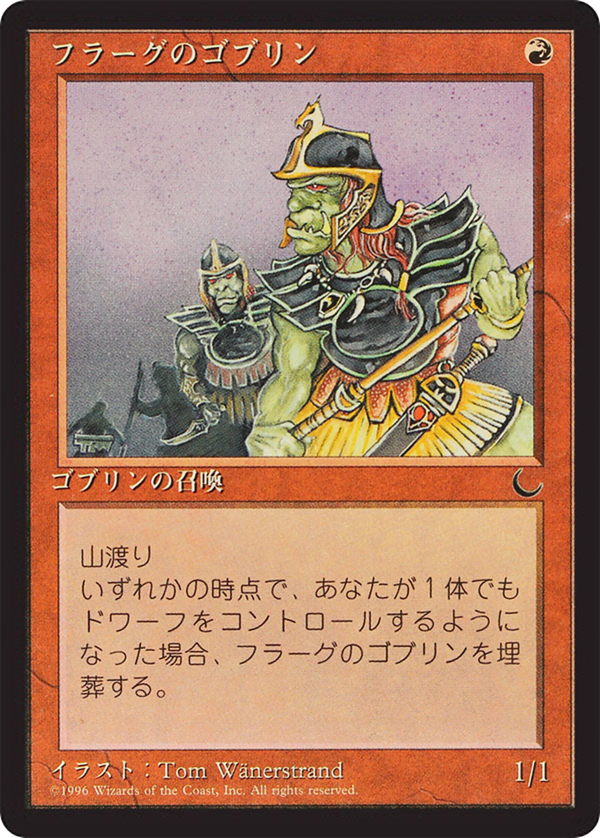
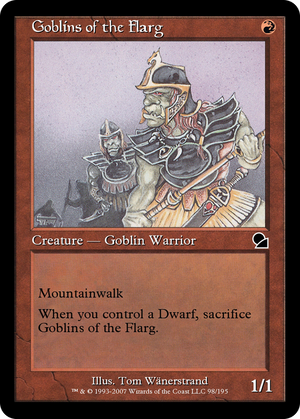
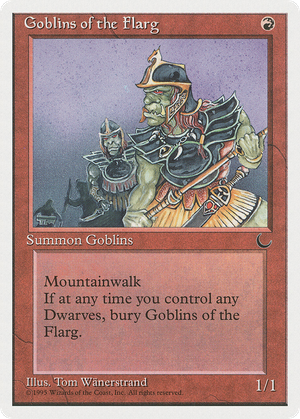
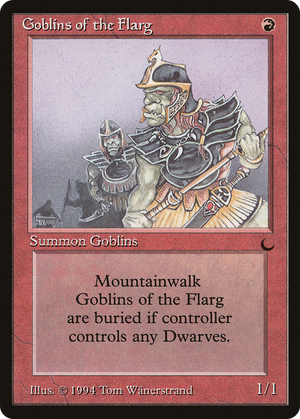
Goblins of the Flarg

The drawback here is fiction enforced by a rules clause rather than a balancing knob in any modern sense. Goblins and Dwarves hate each other in the lore, so the card refuses to serve alongside one: the moment you control a Dwarf, this Goblin sacrifices itself. That is a design conceit that almost never recurred, because the trigger keys not to anything you do but to a creature subtype you happen to control, punishing a deckbuilding overlap a player would have to assemble on purpose to ever feel. The mountainwalk is the other half of the antique sensibility: evasion stapled to a fragile attacker based purely on the defender's mana base, with no thought to how often that condition would actually be live. Strip away the theme and you have a cheap red beater with conditional unblockability and a downside almost no list could trip over, since few decks of the period ran Dwarves at all. It documents how early Magic thought about creatures: as story beats first, board pieces second, with the rules text bending to serve the narrative rather than the game state.