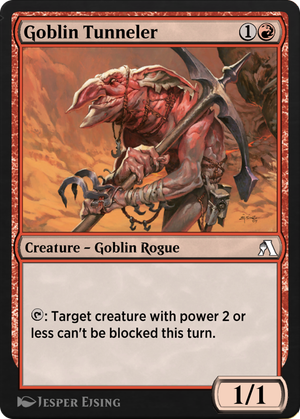
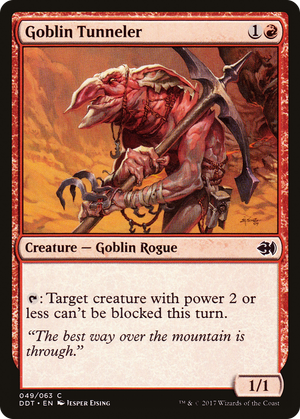
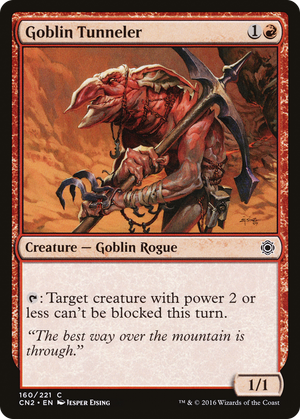
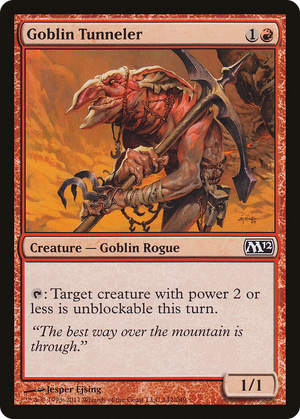
Goblin Tunneler


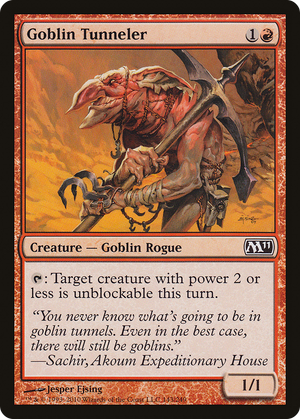
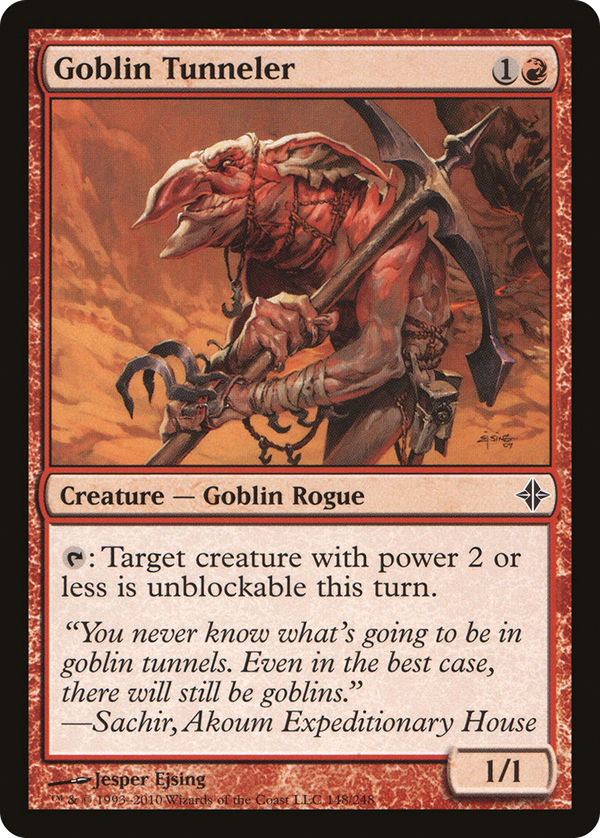
The whole card lives in that power-2-or-less clause, which tells you it was never meant to push a finisher: the threshold restricts the ability to the kind of small body that carries an effect on connection rather than the damage itself. That is where the tap earns its slot. Making a 1/1 unblockable for its own sake is rarely worth a card and an activation, so the target you point this at wants to do something when it lands: a saboteur trigger, a creature you intend to pump after blocks would have been declared, or anything whose value is gated behind combat damage. The repeatable shape is the draw. A one-shot like Distortion Strike spends a whole card to slip an attacker through once; this hands you the same guarantee every turn the Goblin survives, and it survives by staying home, tapping rather than attacking, contributing nothing to combat and asking nothing of it. The fragility is real but it is a removal problem, not a combat one: the engine only breaks if an opponent spends a spell to answer the enabler, because the Tunneler is never on the board to be blocked. The honest read is a dedicated delivery system for a single high-value attacker, a way to guarantee one specific creature's connection turn after turn, valuable in exact proportion to how much that one connection is worth.
Rules text
 : Target creature with power 2 or less can't be blocked this turn.