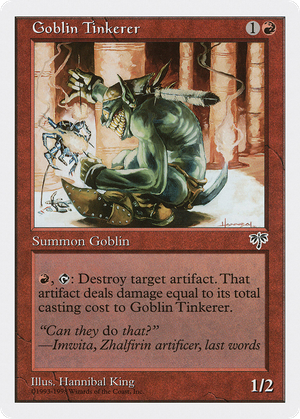
Goblin Tinkerer


Red's older theory of artifact hate, written into a body: the engineer who can take a machine apart but bleeds doing it. The disassembly is built like a literal demolition, the artifact you destroy fighting back for damage equal to its mana value, and the 1/2 frame means that clause bites almost immediately. Anything worth answering tends to cost two or more, so a Signet's mana value of 2 already kills the Tinkerer on the way out; a true mox at zero mana value is one of the only targets it shreds without a scratch. That self-inflicted scaling is what keeps a tap-and-repeat artifact answer honest. Without it, a two-mana body that recursively destroys artifacts every turn would be oppressive in any era with artifacts worth answering. Instead the card self-balances against the metagame around it: clean only against the zero-cost rocks that least need answering, lethal to itself against the costly constructs that hurt most to face. The tradeoff also dictates sequencing, since against the biggest targets you often get exactly one use before the Goblin falls over. This is the engineering before red leaned on cheaper, no-strings answers; the mana-value-as-damage clause is the elegant part, a built-in price that rises precisely with how badly you needed the removal.
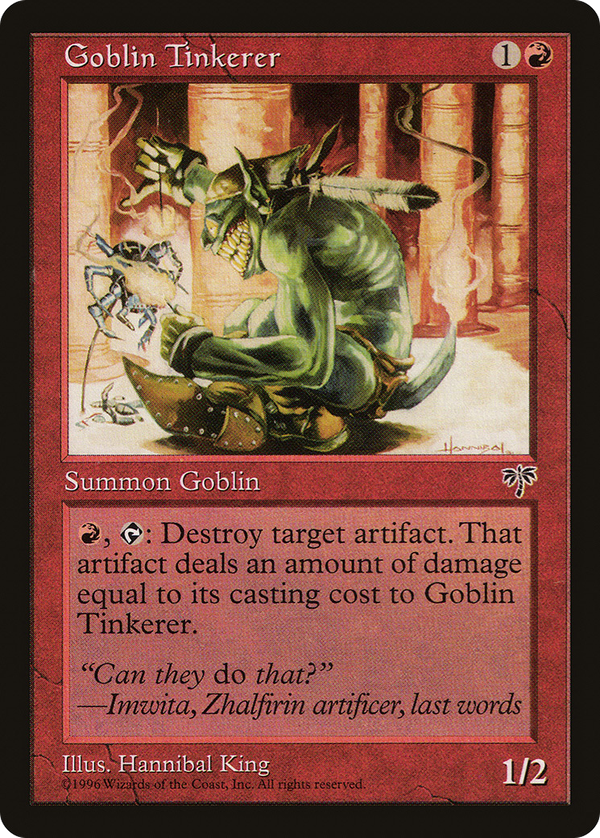
Rules text
,  : Destroy target artifact. That artifact deals damage equal to its mana value to this creature.