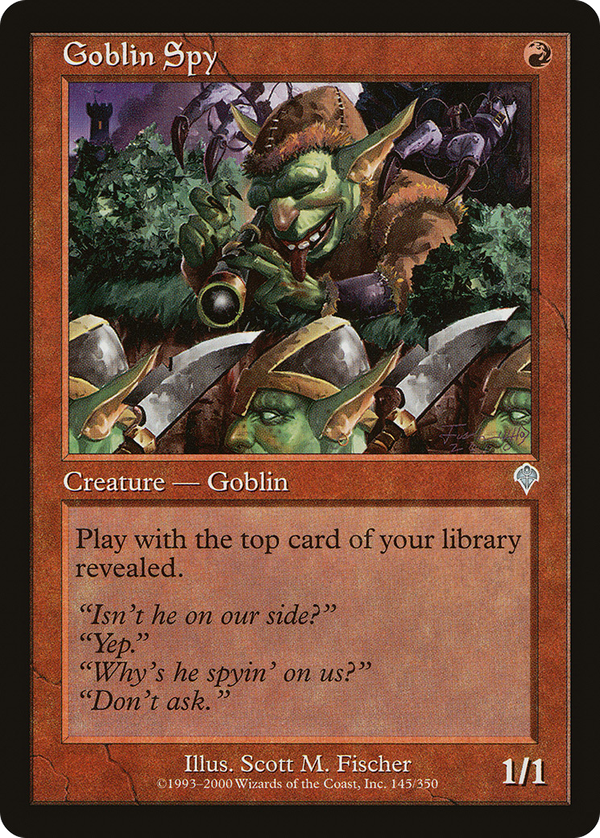
Goblin Spy

Reveal your next draw and you hand your opponent intelligence they often value more than you do. That asymmetry is the whole problem with this little Goblin: it grants the same effect later printings would attach to upside (Vance's Blasting Cannons turning it into card advantage, the broader top-of-library-matters subtheme that eventually paid players for the knowledge), but here, in its earliest creature-stapled form, there is no payoff bolted on. You see one card a turn early, your opponent sees it too, and a 1/1 holds the door. It reads as a flavor joke (a spy who spies on himself, then announces the findings to the table) and plays like one, a common Goblin built before perfect information about your own deck had grown into a mechanic anyone would deliberately want. What it documents is the moment the design instinct still treated this kind of self-revelation as a cost to be offset by a cheap body, rather than a resource to be mined. The card is a fossil of that earlier reflex, wedged between the plain Goblin one-drops it competes with for a slot and the build-arounds that would later make its text line something players paid to put in a deck.