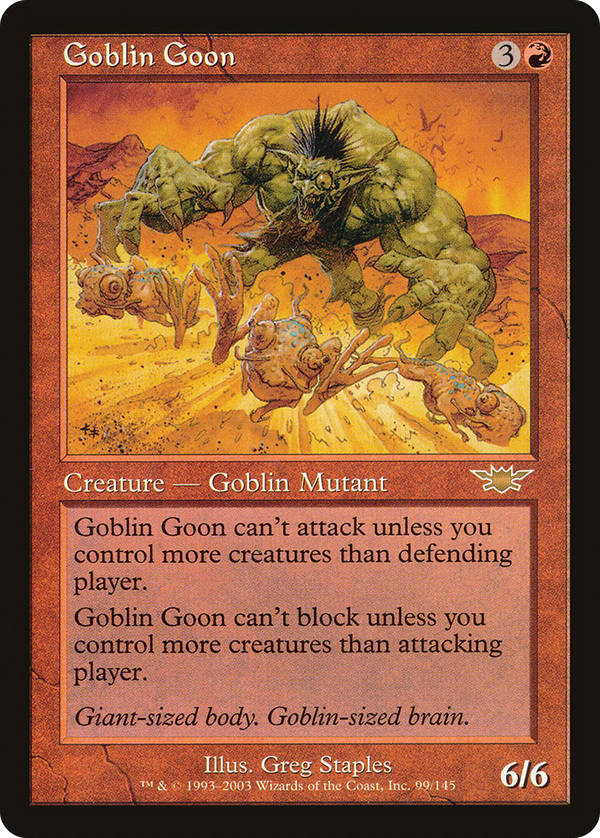
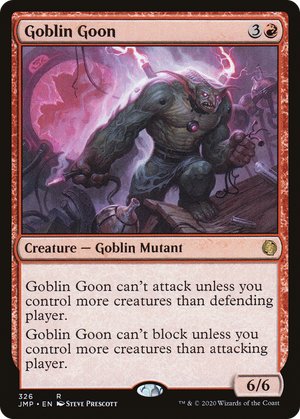
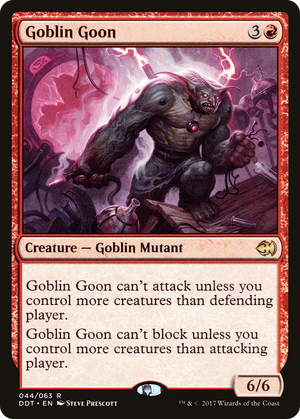
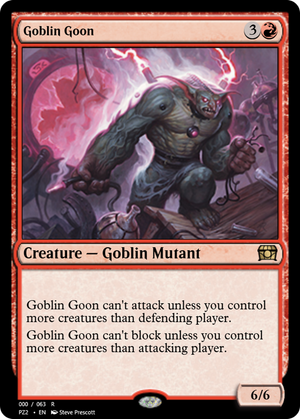
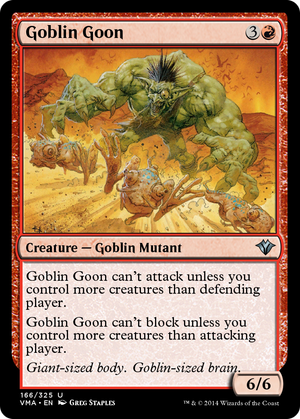
Goblin Goon


A 6/6 for four mana was an absurd rate for its era, and both lines of text exist to claw that price back by tying the body's usefulness to a head count you never fully control. The Goon can attack only when you control more creatures than the defending player, and block only when you control more creatures than the attacking player: not the bodies coming at you, but the opponent's total creature count, which makes the defensive clause the harsher of the two. The design conditions raw stats on a board state that flips every time anything dies on either side. Goblins want to flood the battlefield, so the tribe's go-wide instinct is what switches the Goon on, but the conditions tally creatures, not power, which punishes the very deck that would run it: trade off your small bodies in the early turns and the giant suddenly cannot swing or hold the line. On offense the Goon usually gets there, since outnumbering the defender is the natural aggressive position, but as a blocker it asks you to keep a wider board than an opponent who only needs to commit creatures, not attack with them, to shut the gate. That asymmetry, governed by a tally the card cannot enforce, is what kept it a curiosity: a memorable lesson in how a creature's rate is only ever as good as the conditions wrapped around it.