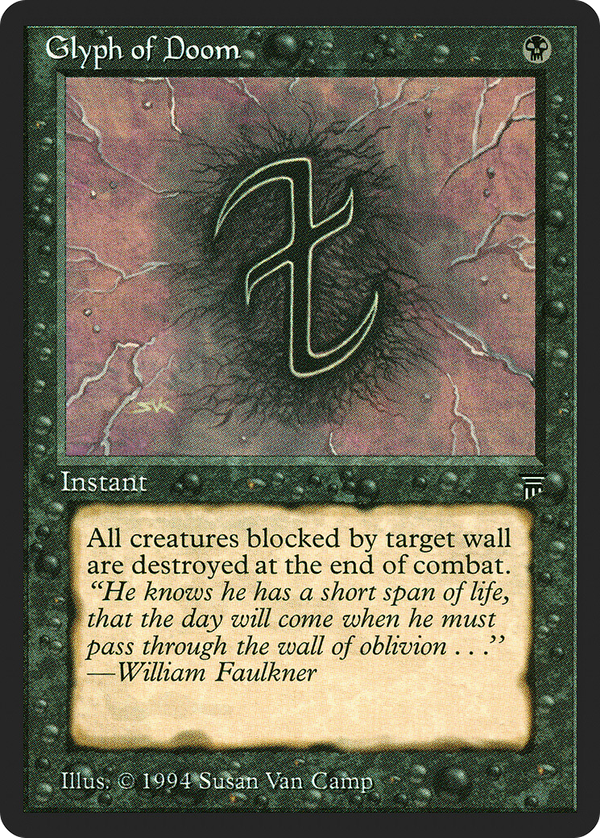
Glyph of Doom

The Glyph cycle is an early-era design experiment few players remember and fewer have ever resolved: cheap instants that turn a Wall into a one-shot trap, rewarding the player who built a defensive board into a punishing tempo swing. The mechanical conceit is the interesting part. Walls then were almost purely defensive (most could not attack under the old rules), so the Glyphs gave the Wall player a reason to invite an attack rather than simply absorb it. Block with the Wall, cast the Glyph, and at end of combat whatever that Wall blocked is destroyed regardless of toughness or the damage it took. The black version is the cleanest of the cycle because unconditional destruction needs no further sizing: the Wall trades up against an attacker it has no business stopping, the toughness math irrelevant once the end-of-combat trigger resolves. The scope, though, is narrow by intent. The Glyph only kills what the Wall actually blocked, which under normal rules is a single creature: this is a conditional one-for-one priced for the contingencies stacked on top of it, not a sweeper. It comes from a stretch of design when combat tricks keyed off static creature types and the end-of-combat window was a novel piece of timing rather than a standard tool. Three conditions (owning a Wall, surviving block assignment, an opponent willing to attack into it) gate a one-mana effect, which is the design grammar of its era in miniature.