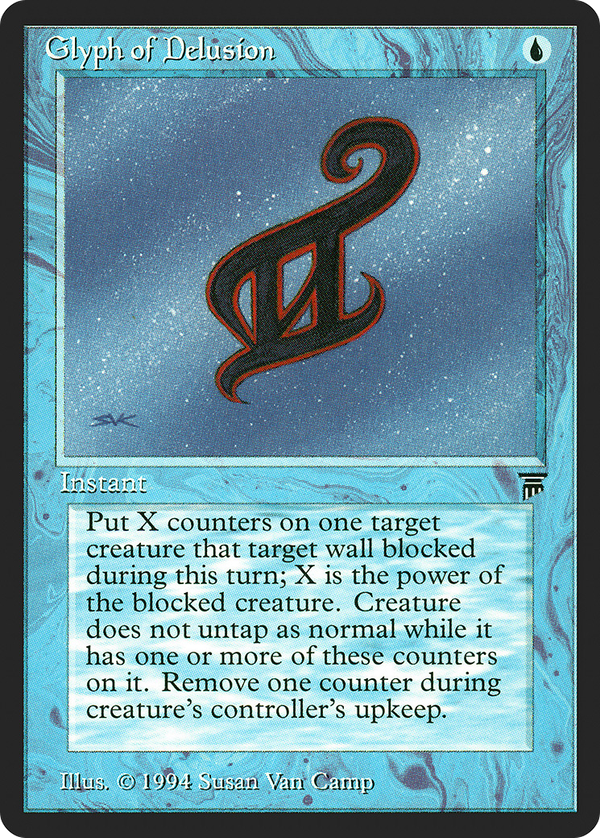
Glyph of Delusion

Walls in Legends were a strange design corner: defenders with no offensive output, balanced by being statistically generous on the defensive axis. This is the cycle's attempt to give them a payoff that converts successful blocks into something more permanent than a saved life total. The structure is unusual on multiple axes. It cares about the combat that already happened (a backward-looking targeting restriction, rare in the color), it scales its lockdown to the attacker's own power (the bigger the threat, the longer it stays tapped), and it builds a self-decrementing prison rather than a hard removal effect. That last piece is the design feature that has aged most interestingly: the glyph counters tick down one per upkeep, so the lock has a knowable expiration date that both players can plan around. The whole cycle (one Glyph per color, each keyed to a different wall-block trigger) reads as Wizards probing whether a defensive subgame could be its own archetype. It could not, at least not at these rates and not with this much setup. What survives is the design artifact: an instant whose entire text is contingent on a board state most decks were never going to produce, written in a counter vocabulary the game would not formalize for another fifteen years.