Gliding Licid


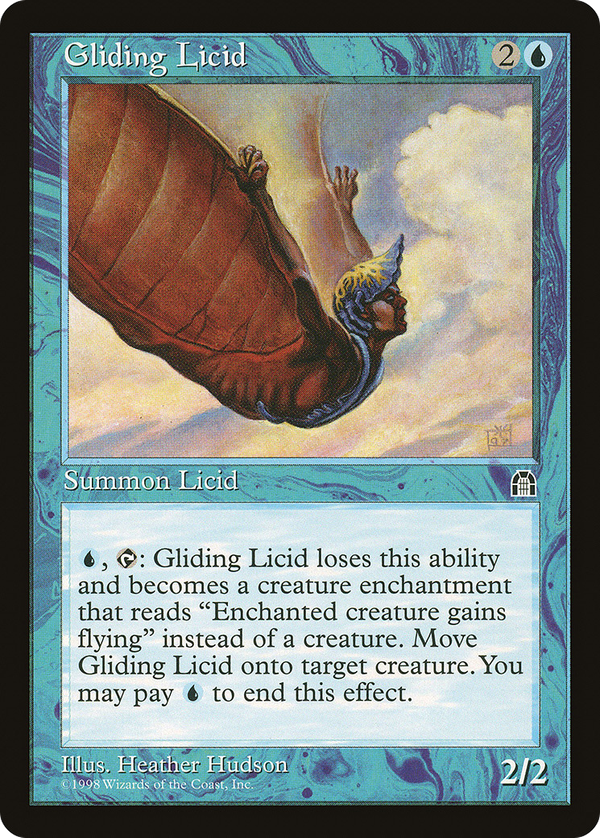
Auras have a structural problem: they are sticky, and stickiness cuts both ways. A traditional flying-granting Aura commits to one creature and dies with it, so if the board shifts, the investment is stranded. Stronghold's design answer was to make the Aura a creature first, one that can detach and reattach. The pay--to-end clause turns the enchantment back into a 2/2 body whenever a grounded attacker is worth more than a flier, and that reversibility is the pitch: you rent evasion rather than buying it, and you keep the deposit. But the modularity is gentler than it looks. Reattaching requires tapping again and paying mana, which means the flying cannot be slid from blocker to attacker within a single combat the way a cheaper trick might suggest; moving it is a commitment of the creature's tap, not a combat-phase pivot. The cost of the whole design is that the body does two jobs at half efficiency, a fragile creature and a slow, mana-hungry Aura, neither as well as a card built for one purpose. Today the template reads as a connoisseur's curiosity, partly because the original wording was notoriously convoluted (the rules text has since been errata'd to read cleanly), and partly because the problem it solved was a niche one. As a snapshot of late-'90s experimentation with creatures and enchantments sharing a type, though, it expresses the idea cleanly: an Aura that knows when to walk away.
Rules text
,  : This creature loses this ability and becomes an Aura enchantment with enchant creature. Attach it to target creature. You may pay to end this effect.
Enchanted creature has flying.
: This creature loses this ability and becomes an Aura enchantment with enchant creature. Attach it to target creature. You may pay to end this effect.
Enchanted creature has flying.