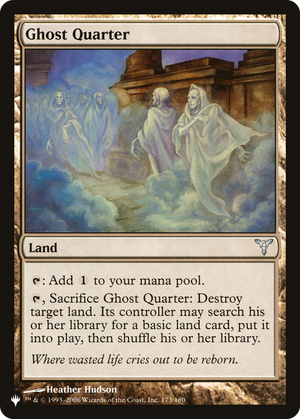
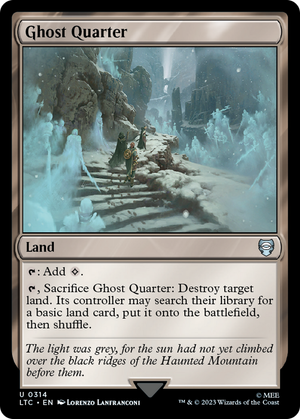
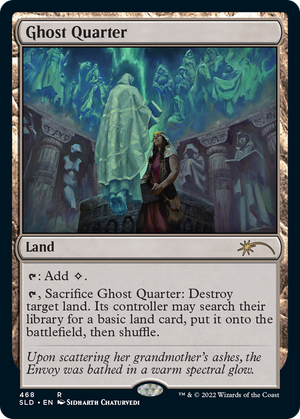
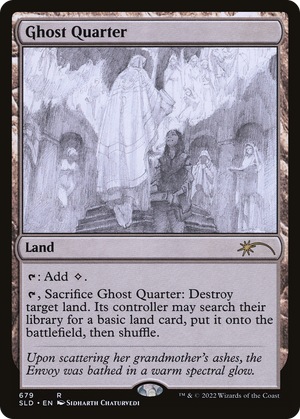
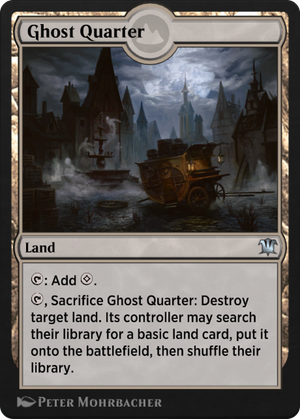
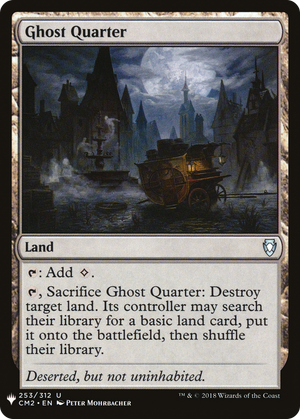
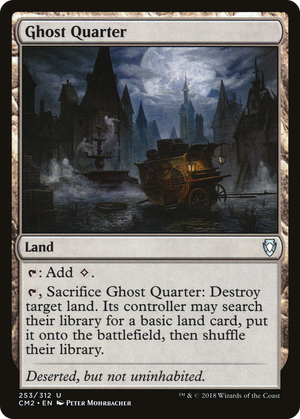
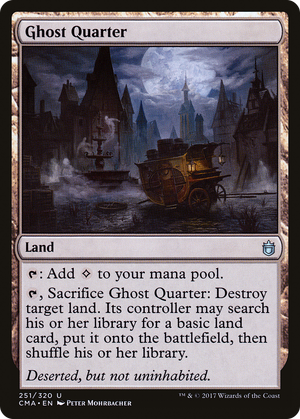
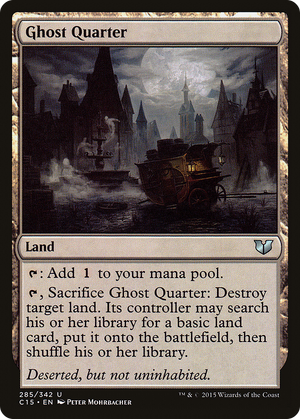
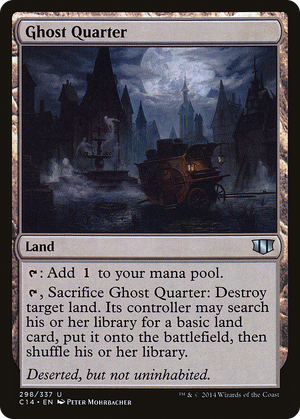
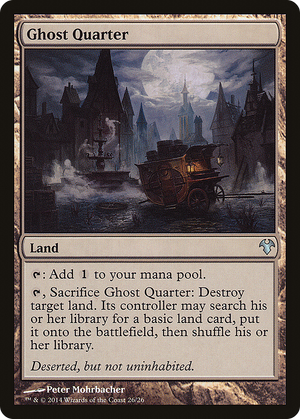
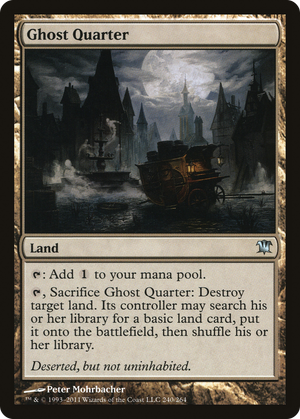
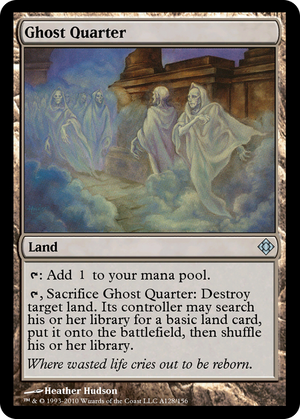
Ghost Quarter
The trade it offers is the whole negotiation: you destroy any land, but you hand its controller a basic in return. That clause is what separates this from Strip Mine and Wasteland, the older land-destruction lands that asked nothing back, and it is also what keeps this one legal where those two are restricted. The compensation reorients the threat entirely. Against a nonbasic the opponent cannot easily replace (a manland, a creature-land, a key utility land, an unfetchable dual), the basic in return is a downgrade, not a wash, so the destruction lands hard. Against a deck that wants its basics anyway, the symmetry softens: you spend a land to put the opponent at parity while thinning their library for them, which is a poor rate for you and a courtesy for them. The real prize is the deck that runs zero or one basics: there the search clause whiffs entirely, and a single colored source can be erased with no replacement at all. That asymmetry, punishing the greedy manabase while paying off the humble one, is what keeps the card printable without a leash. It taps for colorless in the meantime, so holding it up never costs you a turn of mana; you simply leave it back, untapped and patient, until a land worth destroying hits the battlefield. It does not win games. It denies them, one specific land at a time, and the denial is sharpest precisely where it costs the opponent something a basic cannot buy back.
Rules text
 : Add
: Add  .
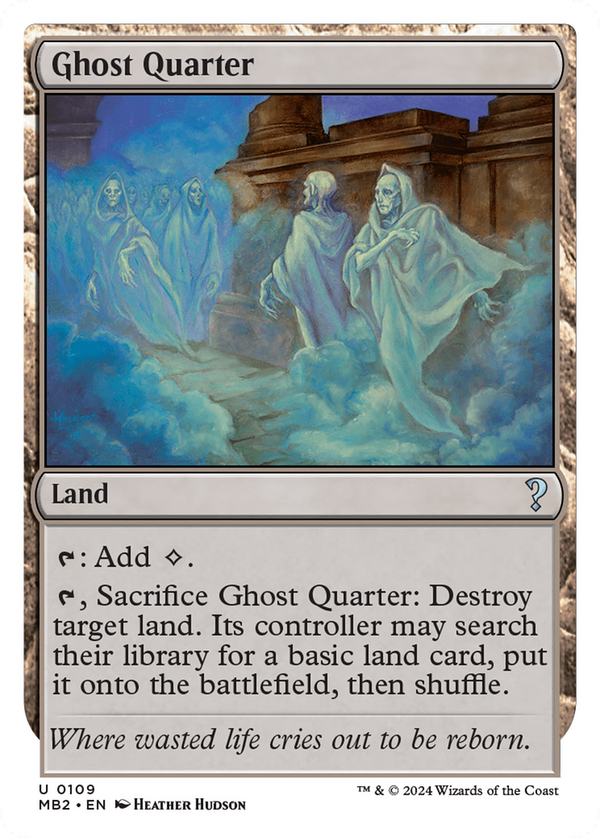
, Sacrifice this land: Destroy target land. Its controller may search their library for a basic land card, put it onto the battlefield, then shuffle.
.
, Sacrifice this land: Destroy target land. Its controller may search their library for a basic land card, put it onto the battlefield, then shuffle.