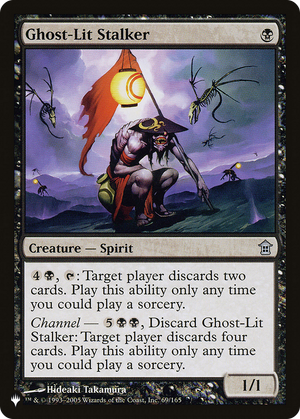
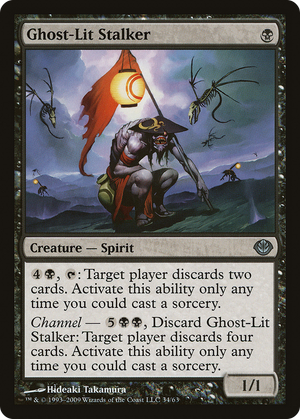
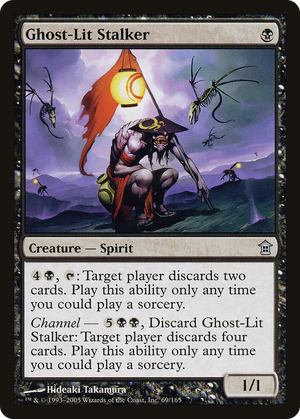
Ghost-Lit Stalker

Forced discard was a recurring black experiment in this era, and few designs put the effect on a body this literally. The Spirit itself is a one-mana statement of intent that does nothing until you have spent the better part of a game's mana to make it tap for a two-card discard, on your own turn only. That sorcery-speed leash matters: instant-speed forced discard at this cost would warp how an opponent could sandbag answers. The Channel mode is where the logic clarifies. Instead of grinding value turn after turn through the tap ability, you pitch the Spirit itself for a single larger strike, trading the long-game engine for an immediate four-card emptying. Slow recurring discard versus one decisive cut: that fork is the entire design. Both modes share the same flaw, though, which is that each asks for so much mana that the window where forcing discard still matters has usually closed. By the time you can afford either ability, the opponent has typically deployed the cards you wanted to strip. The result is a hand-disruption creature whose gating is more thoughtful than its math: a study in how to price discard onto a permanent, hamstrung by the price it landed on.
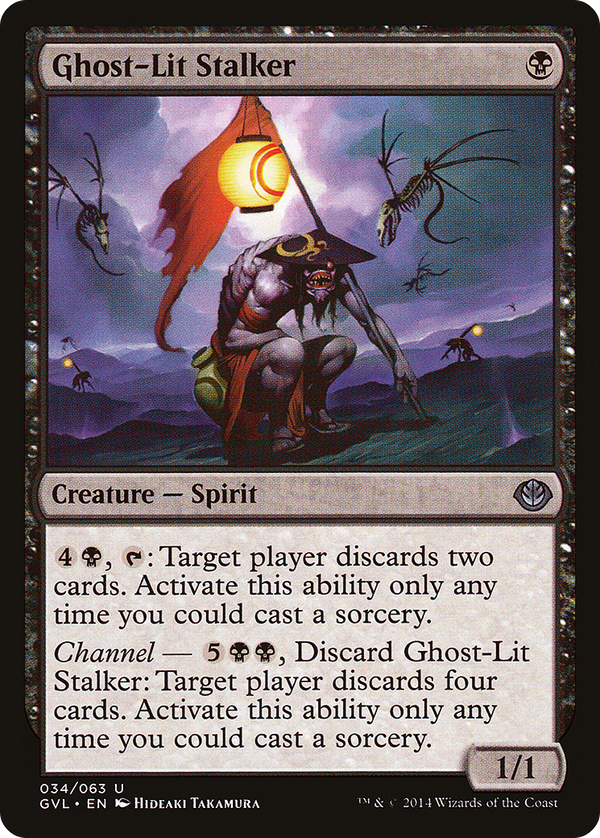
Rules text
 ,
,  : Target player discards two cards. Activate only as a sorcery.
Channel —
: Target player discards two cards. Activate only as a sorcery.
Channel —  , Discard this card: Target player discards four cards. Activate only as a sorcery.