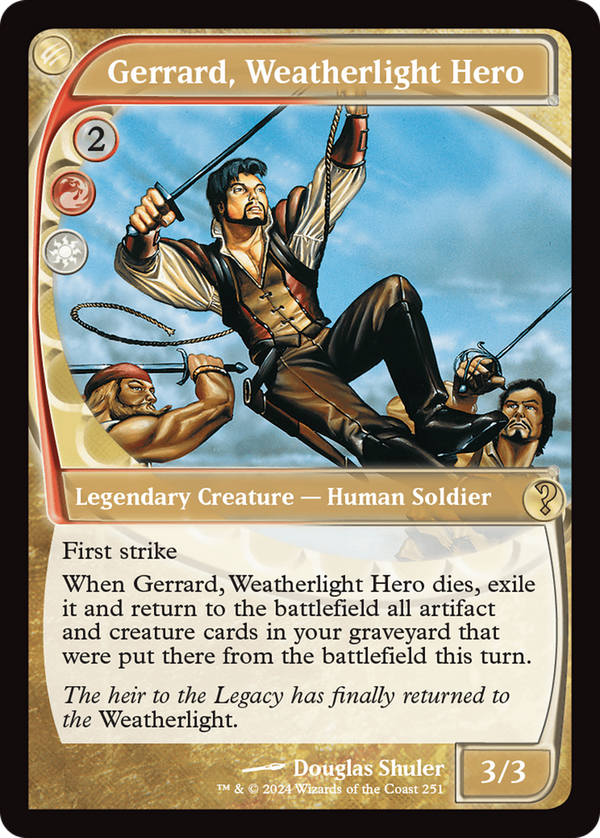
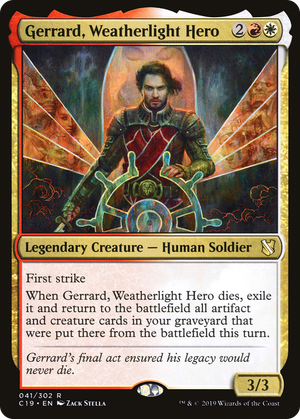
Gerrard, Weatherlight Hero



Death is supposed to punish the aristocrats deck; here it funds it. The trigger cares about a very specific class of casualty: not everything in the yard, only the artifact and creature cards that hit it from the battlefield this turn. That timing clause is the entire engine, and it comes with a hidden restriction that shapes the whole build: tokens cease to exist on the way to the graveyard, so they are not coming back. What this reloads is real cards. Sacrifice a board of actual permanents to an outlet, let it die to that same outlet or to a blocker, and the pile returns at once with enter-the-battlefield triggers primed to fire again. This is mass reanimation stapled to a body, fired once, and the reload has to be staged inside a single turn's dying, which is where the deckbuilding tension lives: you are not looping value slowly, you are detonating a turn's worth of sacrifices into a single resurrection. The self-exile on the death trigger is the honest cost of the bargain, since it cannot return alongside the crowd it saves. As a red-white legend, it sits in a color pair that rarely gets graveyard payoffs at all (recursion is usually black or green), which is what makes the effect a genuine departure for the pairing. The first-striking body is almost incidental; nobody runs this to attack, they run it because dying, on the right turn, is the best thing it does.