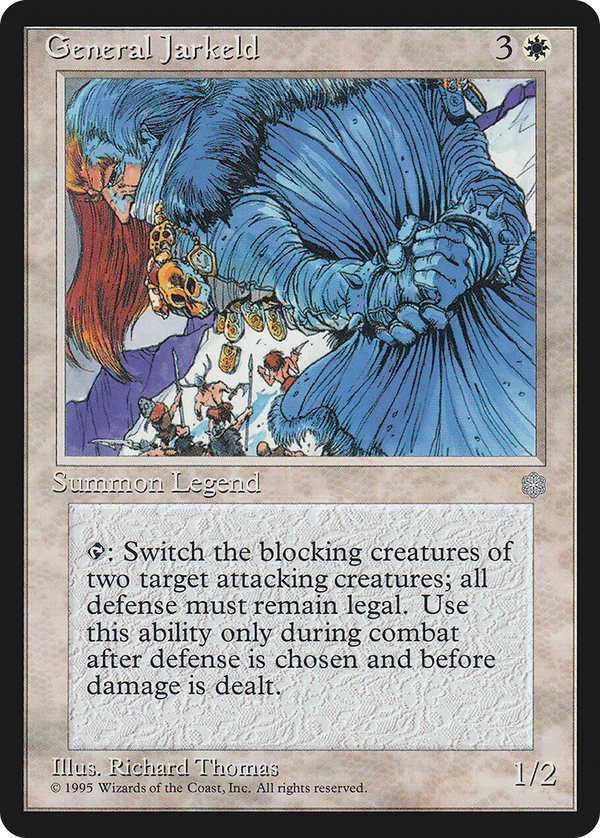
General Jarkeld


The high-water mark of combat-trick complexity, and a window into how willing early design was to make a card the player had to re-read three times before activating. The ability swaps two attackers' blockers, but only when the assignment is legal in both directions: every creature blocking one must have been able to block the other. That legality clause is the whole puzzle. Untangling whether a given board state even permits the swap is harder than the play it enables, and the payoff is a defensive reshuffle where a wall of blockers suddenly gangs the wrong attacker, leaving the other facing only the leftover blockers (often a single creature that can no longer trade favorably or survive). The effect reads as a logic problem rather than a game action: a strict targeting parameter masquerading as a tactical option. The 1/2 body and the declare-blockers-only restriction keep the rate honest; this was never meant to swing tempo on its own, only to reward a defender who saw the trap two blocks ahead. What makes it a relic is the era it belongs to: an age when Wizards trusted players to parse a paragraph of conditional combat math at instant speed, before templating discipline pushed effects toward legibility. The card still works exactly as printed; it just asks for a board state precise enough that most games never present one. A genuine artifact of design before the modern emphasis on a card doing one clear thing.
Rules text
 : Choose two target blocked attacking creatures. If each of those creatures could be blocked by all creatures that the other is blocked by, each creature that's blocking exactly one of those attacking creatures stops blocking it and is blocking the other attacking creature. Activate only during the declare blockers step.