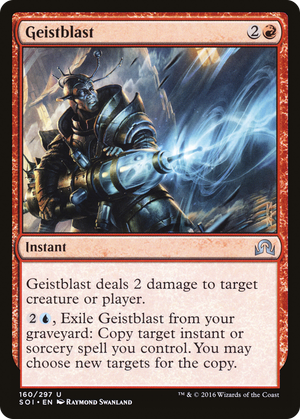
Geistblast


Read it as two cards stapled together that share nothing but a frame. Up top is a workmanlike two-damage instant, the kind of removal that trades for a small creature and otherwise sits in hand. Underneath is the reason anyone runs it: a graveyard ability that exiles the card as part of its cost to copy any instant or sorcery you control, with the right to repoint the copy. That split is what makes it interesting to build around, because the two halves want different decks. The damage rewards a creature-light board; the copy rewards a spellslinger shell stacked with burn, card draw, or a single high-value sorcery worth duplicating. The blue half of the activation is the discipline holding it together: a card that copied your spells for free would be a different conversation, so the design taxes you across two colors and demands you spend the dead card itself to do it. Self-exile as a cost matters too, since it caps the engine at one copy per Geistblast rather than a recursive loop. The result is a removal spell that gets better the longer a game runs, sitting in the bin as a deferred copy effect rather than a flooded blank. It is the rare two-mode card where the throwaway mode and the payoff mode cost the same three mana, yet the conditional, late-game one is the real reason it earns a slot.
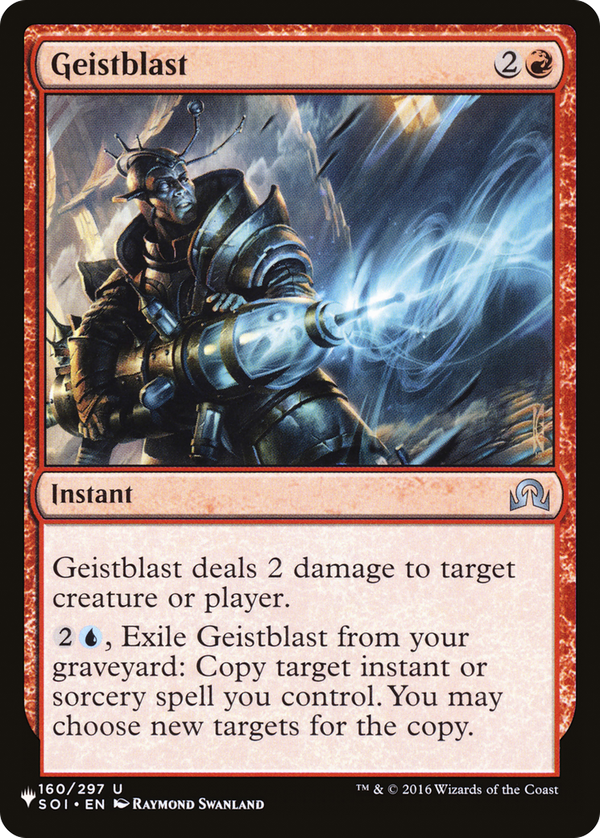
Rules text
 , Exile this card from your graveyard: Copy target instant or sorcery spell you control. You may choose new targets for the copy.