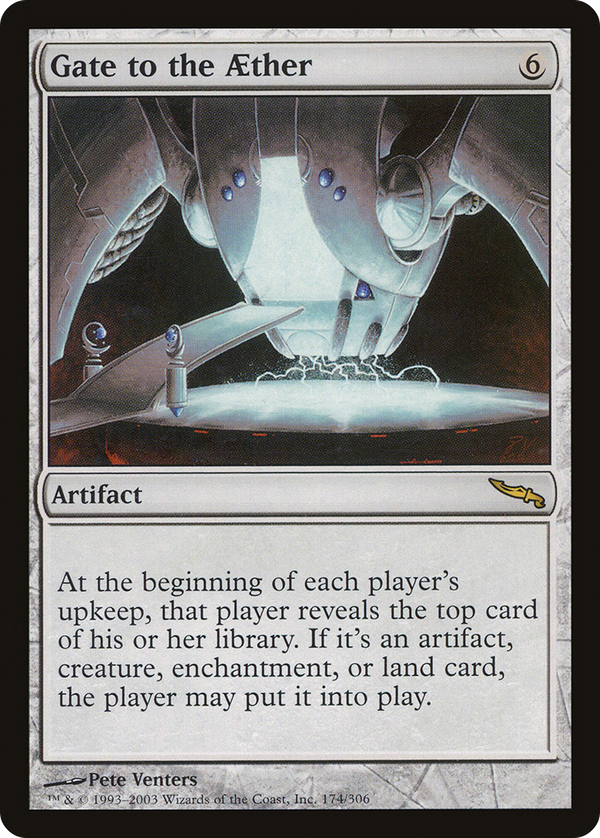
Gate to the Aether

Symmetry is the trap built into this design. The reveal-and-deploy happens on every player's upkeep, which means the engine you spent six mana to assemble feeds your opponents' boards as readily as your own. That is the tension the card never resolves: a free-permanent faucet with no valve, no way to point it only at yourself, no way to shut it off when the top of an opponent's library is more threatening than the top of yours. The whiff condition compounds the unreliability: instants and sorceries get revealed and stranded, so a deck running enough of those turns the trigger into a glorified, public reveal that helps everyone read the board. What it wants is a library stuffed with high-impact permanents and an opponent's library that is not, a condition you cannot engineer from your side of the table. Effects that hand free permanents to all players have always lived in the same uneasy place: the payoff is real, but the build-around has to neutralize the gift to the other side before the engine earns its keep. Gate to the Aether offers the raw effect and none of the controls, which leaves the payoff theoretical for anyone not building both libraries by hand. The interesting part is structural, not practical: it is what a symmetric permanent-cheating artifact looks like before designers learned to staple asymmetry or an off-switch onto the same idea.