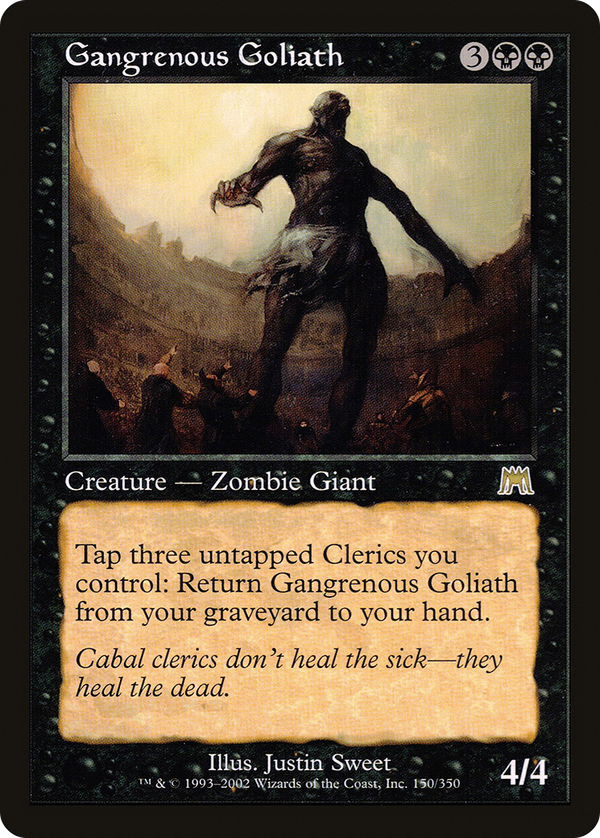
Gangrenous Goliath


Cleric tribal wanted a threat that refused to stay buried, and this 4/4 answers by denominating its own return in the resource the deck already hoards. There is no mana to find: you tap three untapped Clerics, and the Goliath crawls back from the graveyard to your hand, ready to be cast and killed and recurred again. That reframes the body entirely. You are not casting a Zombie Giant once and grieving when it dies; you are spending a turn's worth of Cleric activity to reload a sacrifice-fodder beater for as long as the small bodies keep tapping. The design serves the deck around it: with a wide bench of Clerics, the engine churns indefinitely; with the board stripped, the card sits inert in the yard with no way home. That dependency is the point. Tribal blocks of the early era leaned on payoffs that scaled with creature-type density, and this is the black-aligned recurring threat in that frame, a repeatable attacker for grindy attrition games where chump-blocking and sacrifice loops want something that comes back. The elegant part is how the cost solves the usual recursion problem. Letting a creature return for free invites abuse; letting it return for mana competes with everything else you want to do. Charging the return in tapped Clerics keeps every reanimation expensive on the battlefield while leaving your mana untouched, so the loop stays honest without ever asking you to pass a turn doing nothing else.