Gang Up


The Assist keyword turns a private removal spell into a negotiated one, and that reframing is the whole point. Most variable-cost kill spells scale off your own resources: how much mana you can pour into X dictates how big a creature you can answer. Here the power ceiling is shared. You set the value of X and choose the target, but one other player at the table can pay up to X of the cost, meaning the spell that kills the threat menacing the board can be partly funded by someone else the threat menaces. The black half of the cost is the part that stays yours; everything above it is open to a single willing partner. That structure produces a quietly social bit of game theory: the right play is often to announce the kill, name a target someone else badly wants gone, and let that player cover the variable freight. It is removal designed for a table where multiple players can sit on the same side of a spell rather than for a duel, where the deal is explicit and the politics are baked into the casting. It answers a structural problem single-target removal never had to confront: when a threat is more than one player's problem, why should one player pay the full freight to solve it, and how do you build a card that lets two hands settle the bill at once.
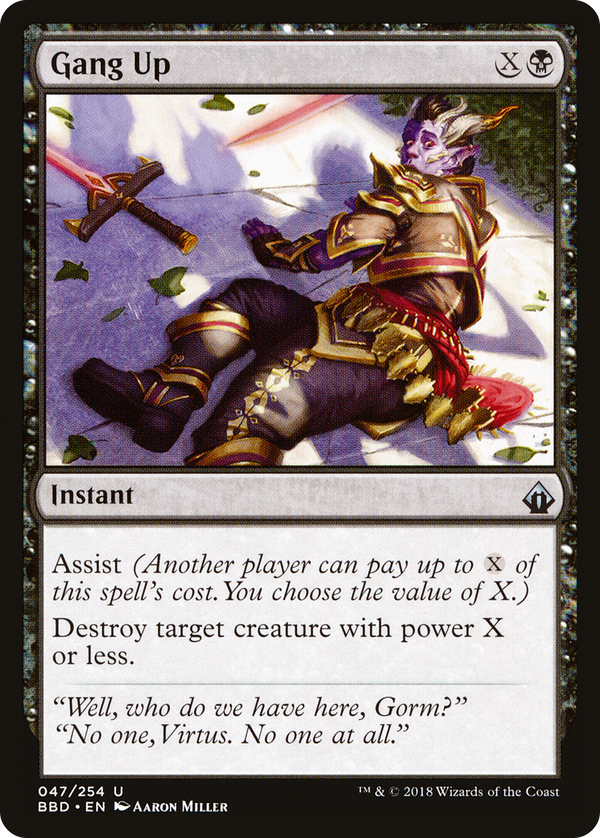
Rules text
of this spell's cost. You choose the value of X.)
Destroy target creature with power X or less.