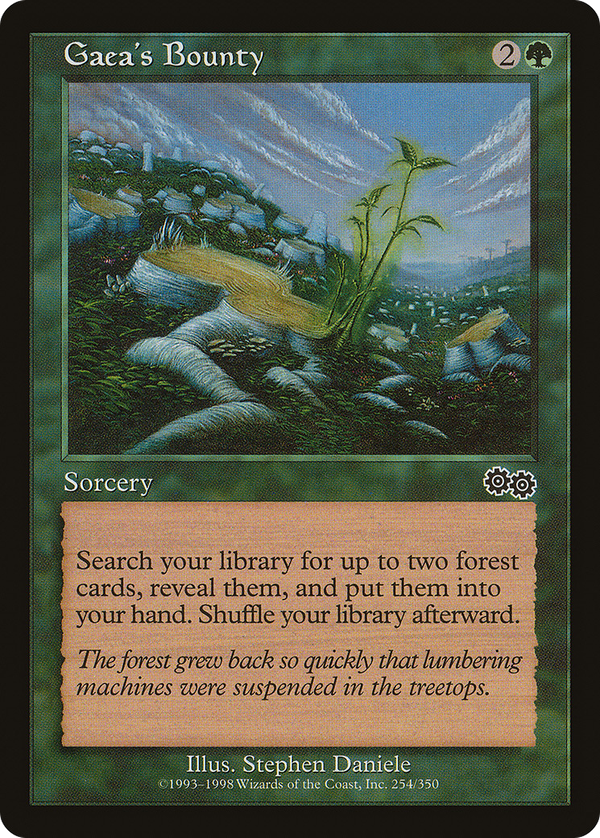
Gaea's Bounty


The trade is right there in the body: pay three mana and a card to net two Forest cards delivered to your hand rather than the battlefield. That last detail is the whole design. This is not ramp; it is thinning and consistency. Pulling two lands out of the library shrinks the deck and raises the odds every subsequent draw is a spell, while guaranteeing the green sources a midrange or ramp shell needs to keep its curve honest. The cost is tempo: a sorcery-speed setup spent on future turns instead of advancing the board in front of you, which is why the effect reads as a deckbuilding luxury rather than an engine. The restriction to Forest cards (not any basic, not any land) is more flexible than it looks, since it reaches anything carrying the Forest subtype: dual lands, shocklands, the various nonbasic Forests that came later. What it still demands is a green-heavy mana base willing to run those cards in quantity. It belongs to a long green tradition of converting a card and some mana into raw consistency, the same impulse that later produced cheaper, cleaner smoothers; what dates this one is the rate, three mana for a tutor-to-hand whose payoff lands entirely on later turns, in a color that learned to do the job faster.