Gaea's Avenger


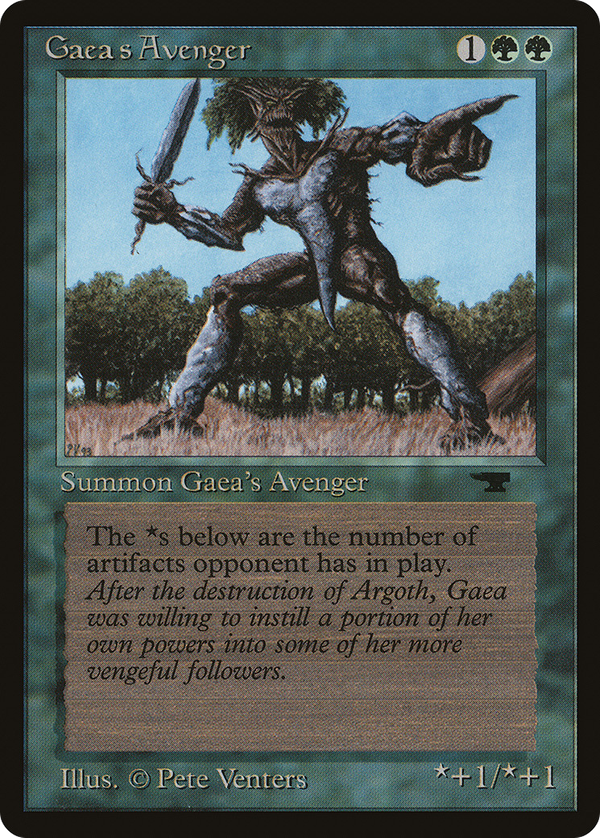
Hate cards in early Magic were almost universally narrow: a sideboard creature with protection from a color, a spell that punished a single keyword, an answer that read like a flowchart. A variable power-and-toughness Treefolk in a set built entirely around artifacts is a different proposition. Rather than naming what it hates, the card lets the opposing board state name itself: every Ornithopter, every artifact ramp piece across the table is a +1/+1 you did not have to pay for. The floor is a vanilla 1/1 for three mana (unplayable in a vacuum), and the design accepts that floor because the artifact-saturated context it was printed into guaranteed the ceiling. The stat line is a referendum on the format around it: the body the opponent's deck builds for you, scaling with the very thing you most want to punish. The Treefolk type is doing flavor work the rules cannot, the forest's reply to a world of clanking machines, a body that grows in proportion to the offense it answers. The discipline of letting the opponent assemble your creature, rather than handing the green deck a fixed stat line and a static prohibition, took a long time to resurface, and it shows up later in size-by-opposing-board designs that owe this template more than they advertise. As a piece of design history it reads richer than it casts; the variable-stat hoser as an idea has roots here.