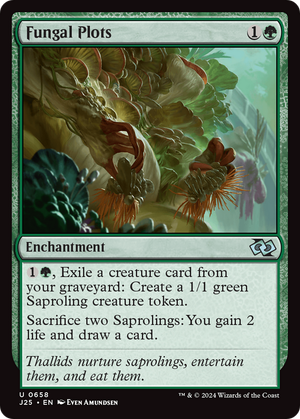
Fungal Plots


The clever part here is the conversion rate: dead creatures in your graveyard become a renewable token engine, and those tokens then loop into life and cards. Most graveyard recursion either returns a creature whole or grinds value one card at a time; this turns the graveyard into raw fuel, exiling whatever died to manufacture bodies of a different shape entirely. That body shape matters because the second ability only wants Saprolings, two at a time, and it pays in both life and a fresh card. The result is a closed circuit that mostly runs on its own waste: a creature dies, gets exiled for a token, and after enough tokens accumulate you cash pairs in for cards. The friction is built into the math. Every loop costs mana and shrinks the graveyard you are drawing from, so the engine is self-limiting rather than degenerate; you cannot churn it infinitely without a creature supply feeding the yard. What makes the design hold together is the tribal anchor: it is a Saproling payoff that also generates its own Saprolings, so it works as a standalone value piece even when the rest of the tribe is thin, then scales up when surrounded by token-makers and sacrifice fodder. Because neither ability carries a timing restriction, both run at instant speed, letting you make blockers on an opponent's turn or draw off a pair of Saprolings in response to a board wipe, converting fodder into cards before it can be swept away.
Rules text
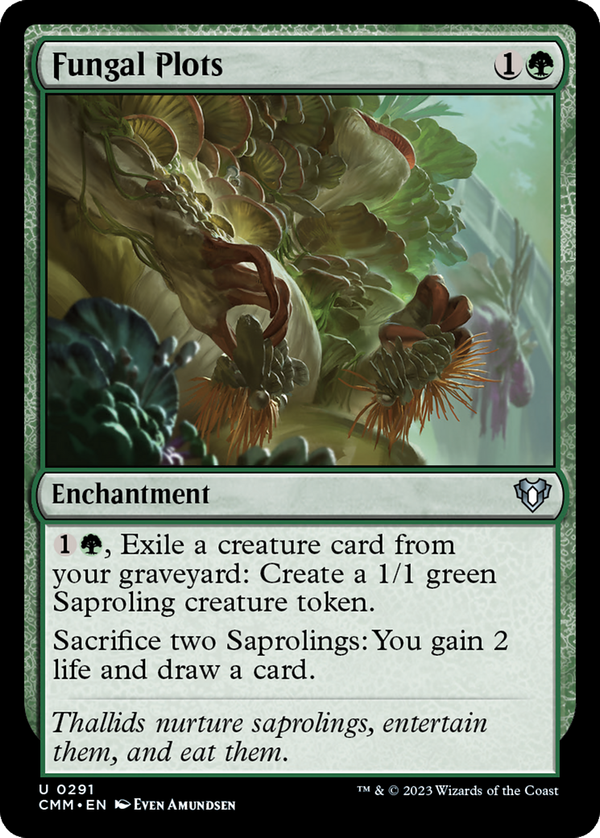
, Exile a creature card from your graveyard: Create a 1/1 green Saproling creature token.
Sacrifice two Saprolings: You gain 2 life and draw a card.