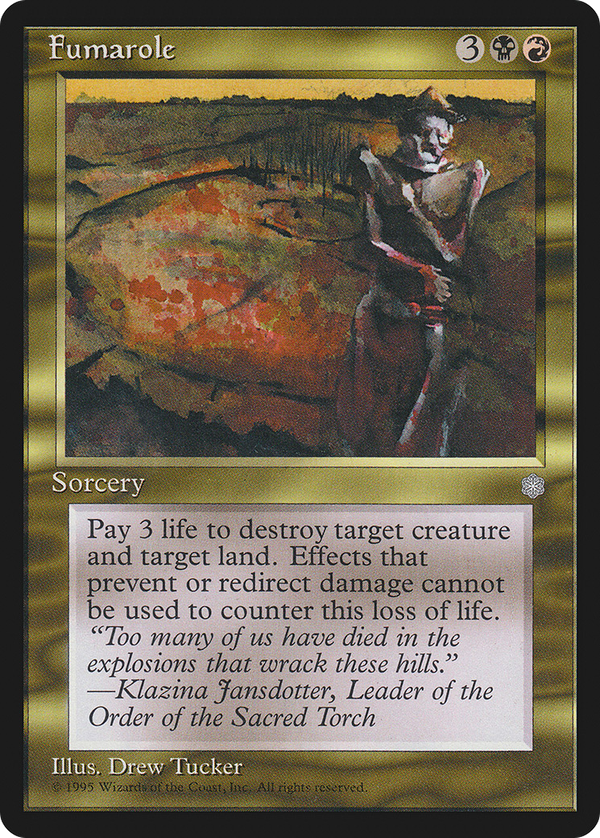
Fumarole



Two destruction effects bolted into one sorcery, with a life payment buying the two-for-one: early design treated this kind of double-removal as inherently fair because it cost five mana, two colors, and a chunk of your life total to fire off. The targeting is what dates it. Both halves are mandatory and independent, so the spell wants a board where your opponent has both a creature worth killing and a land worth stripping. If one of those targets leaves before resolution, the spell still resolves and destroys whatever target remains legal, but you have paid full price for half the package. That rigidity is the point of the design: a card that destroys two permanents of different types in a single sorcery has to be awkward to point cleanly, or it stops being a tempo play and becomes a blowout. The 3-life additional cost is the second governor, a small but real tax that makes Fumarole worse in any deck already bleeding life elsewhere. Read it as a snapshot of how black-red removal was costed before efficiency creep: generous in raw cards-destroyed, deliberately clumsy in everything around the destruction. Later versions of this effect tend to pick one target type and lower the rate; the sprawling two-target sorcery that taxes your life total to do its work belongs to an era that trusted heavy costs to keep flexible removal honest.