Foxfire Oak


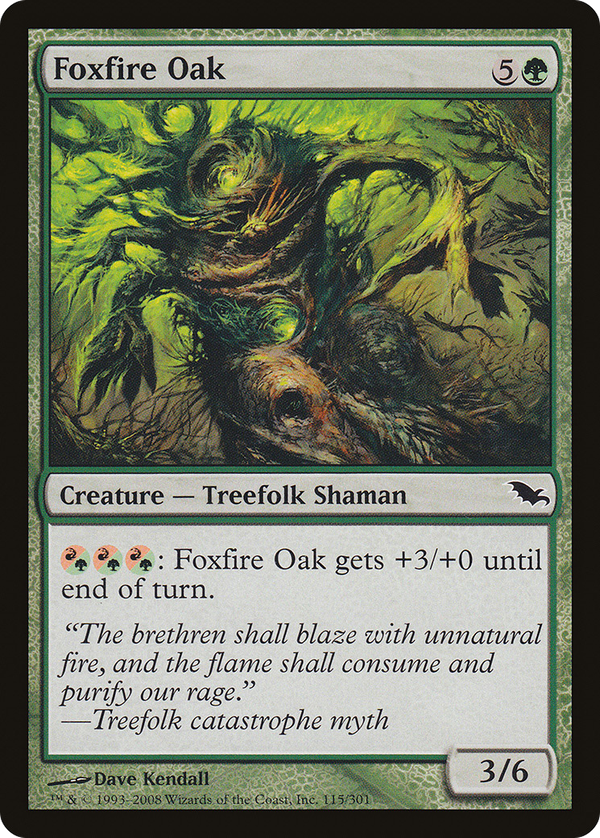
The only line worth reading twice is the activation cost: three mana, each payable with red or green. That hybrid bend is the design point. The ability always costs exactly three, but the colors are open, so a mono-green deck can fuel the firebreathing on Forest mana alone while a red-green build pays it from either pool without warping its lands. The 6 toughness is what licenses the whole arrangement: a body that wide blocks most things it sits across from, which buys the time to hold mana until a turn when sinking it into +3/+0 actually closes a game. Pump-on-the-back-of-a-wall is an awkward pairing by intent, the treefolk content to stall, then becoming a 9/6 or larger once the mana is spare and the swing matters. The shifting cost is the load-bearing idea, a reminder that hybrid mana let designers price an activation against two color pools at once rather than committing it to one, widening the range of manabases that could run the same effect at the same rate. As midrange muscle it is unremarkable; as a demonstration of how flexible cost made a single number serve two different decks, the activation is the only thing on the card that does any work.
Rules text
 : This creature gets +3/+0 until end of turn.