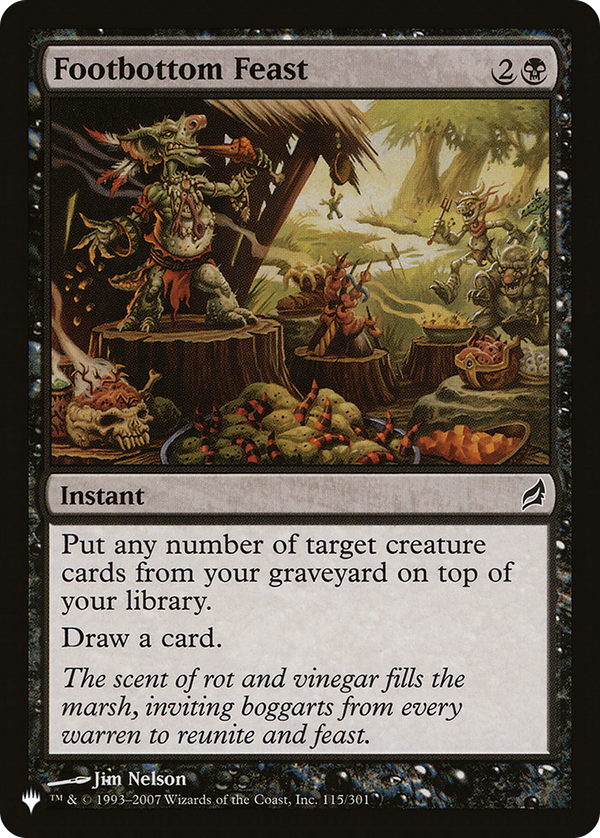
Footbottom Feast


The "any number" clause is doing quiet work that the rate disguises. Most graveyard recursion at this cost retrieves a single card; this one queues an entire dead board for future draws and replaces itself in the same breath. That changes the math for self-mill and aristocrats shells, where the bin is not a backup but a deliberate stockpile: you are not fishing for one creature, you are reloading a stack. The trade is in the verb. The retrieved creatures go onto your library rather than into your hand, so the payback is staggered across upcoming draws rather than immediate, and the cantrip smooths the first one off so the tempo loss does not bite all at once. That delay is exactly why it stays fair: a hand-return version of this effect would be a far stronger card, and the design knows it. It rewards decks that can afford to draw creatures over the next several turns rather than needing bodies now, a narrower brief than instant-speed flexibility suggests. The instant timing matters less for ambushes than for sequencing: because the targeting is selective, you choose precisely which dead creatures to line up, then fire on an opponent's end step to set up your own draw step. A patient, build-around recursion tool, priced for the long game it is built to feed.