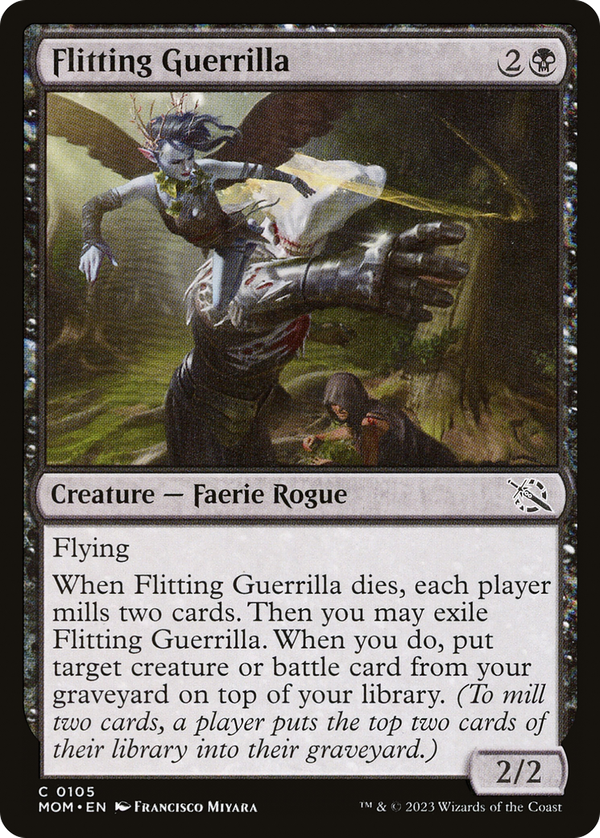
Flitting Guerrilla


The recursion is priced as a death-trigger rather than a cast, and that inversion is the whole design idea. Most graveyard-to-hand or graveyard-to-library effects sit on the enters-the-battlefield or activated-ability side, where you pay mana up front and choose your window. Here the payment is the body's death: it has to die before it does anything, which folds the effect into combat math and sacrifice loops instead of leaving it as a tempo-neutral value play. The mill-two reads as friction against pure card advantage, but on a creature that wants to end up in the graveyard it doubles as self-enabling, seeding the very targets the exile clause fishes back. And the target is narrowed with intent: creature or battle only, put on top of your library rather than into hand, so you are buying a draw step's worth of delay in exchange for a guaranteed hit. The exile step is what keeps this from becoming a repeatable engine on its own; the card removes itself to do the work, so any loop has to import a second recursion piece from elsewhere. What you have is a flier that trades into something, then hands you back your best dead creature at the cost of your next draw: an aristocrats-adjacent value node that rewards decks already sending small bodies to the yard on purpose.