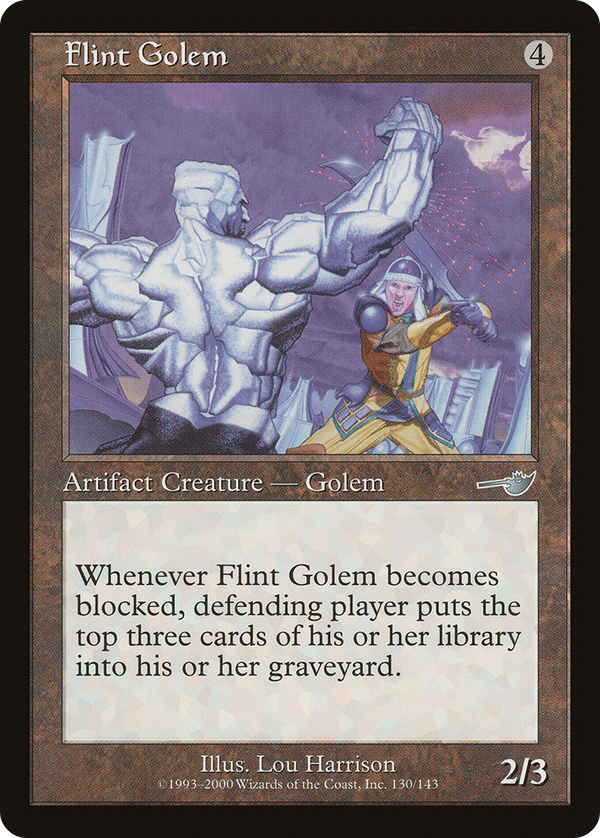
Flint Golem

Mill as a deterrent rather than a clock: the body wants to be blocked, and punishes the defending player for doing the obvious thing. The threat is structured backward from most attackers. A 2/3 with no evasion is the kind of creature you happily chump or trade with, but here every block hands three cards to the graveyard, so the choice becomes "take two, or feed the mill." For most of Magic's history that was a non-threat, since shipping cards to a graveyard was an inconvenience rather than a loss; the milling tribe spent years looking for ways to make those three cards actually matter and mostly came up short. The design is honest about the era it was built in: the deterrent only bites against an opponent who fears decking, and most opponents do not. What it documents is an early attempt to turn milling from a dedicated win condition into incidental chip damage stapled to a combat creature, a hybrid that newer sets have circled back to as graveyard-hate and reanimation made library size a real resource. The body is the limiting factor: at 2/3 it neither pressures life totals nor survives much, so the three-card mill is the whole reason to run it, and three cards a turn is a slow erosion that rarely closes a game on its own.