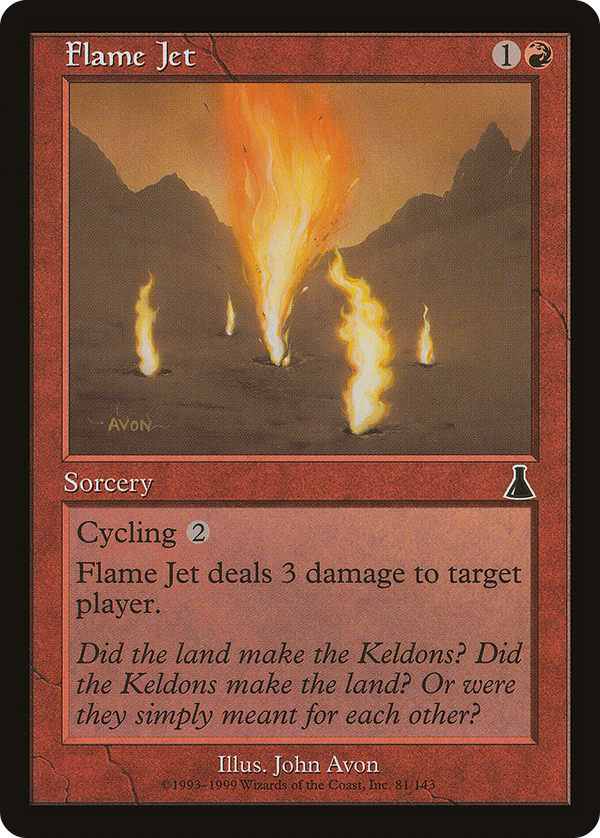
Flame Jet


The cycling cost is the whole pitch. Three damage for would be a serviceable rate on its own, but the design that matters is the floor: when the burn has nowhere productive to go, the card stops being a dead draw and becomes a cantrip for  . That tension defines a class of cycling burn from this era, and the elegance is in the math. The hard-cast cost and the cycling cost sit deliberately close, so the choice between throwing three at a face and refilling your hand is a live decision, made under pressure, with the same piece of cardboard. What narrows the spell to that closing role is the targeting: it never touches creatures, only players or planeswalkers. That is what pushes it toward reach and finishing duty rather than removal, and it is precisely why the cycling clause is structural instead of incidental. A burn spell that can only go upstairs would be a liability against the wrong board; one that draws a card for when the burn is useless is never a liability at all. The lesson it encodes (give a single-axis card a release valve and you can leave the aggressive rate alone) has shown up across every set that has shipped cycling alongside direct damage since.
Rules text
(, Discard this card: Draw a card.)