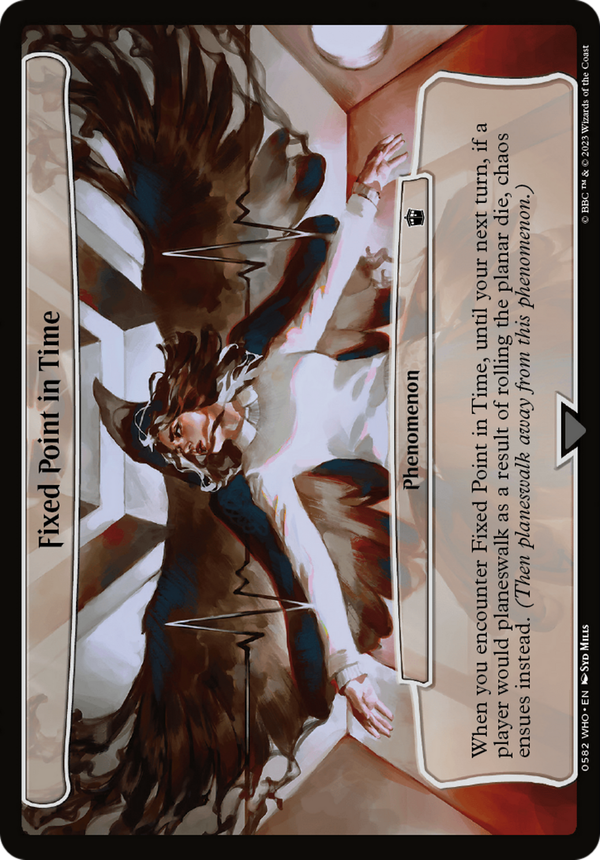
Fixed Point in Time
The planar die is Planechase's release valve: roll it enough and the planeswalk result eventually pulls the table off whatever punishing plane has its hooks in you, resetting the board's chaos around a fresh card. For one window, this phenomenon welds that valve shut. While it holds, the die's planeswalk result stops relocating anyone and detonates chaos instead, so the one outcome players lean on to escape becomes another jolt of on-plane mayhem. The escape hatch you were counting on is repurposed into staying put, which is exactly the temporal lock a "fixed point in time" ought to enforce. Phenomena are already the odd tenants of the planar deck: they have no plane to occupy, they fire the instant you encounter them, and then they shuffle away out of reach, so their whole contribution is a single burst of rule-bending before they cycle out. Here the burst rewrites how the die behaves for the entire table, not just the active player, and it asks for nothing because there is nothing to cast. It is a rules toggle wearing a card's clothes, and its bite is in what it withholds: the reliable out Planechase otherwise guarantees, suspended for a turn.