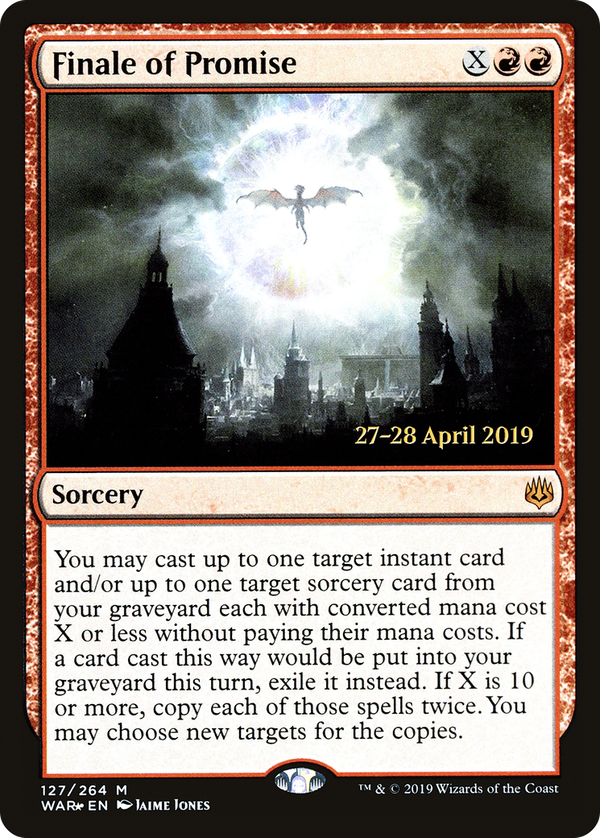
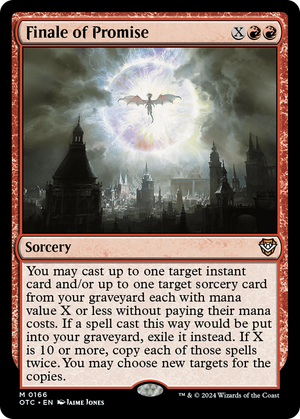
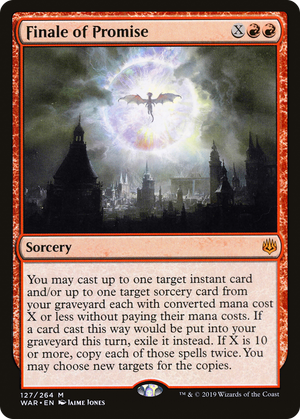
Finale of Promise


The scaling clause reverses how spell-recursion usually pays for itself. Most graveyard-recasting effects charge you full price and take a whole extra turn to matter; this one asks only that the spells you want back have mana value X or less, then hands both of them back for the same X you already spent on the mana cost. The exile-instead clause is the tax that stops it looping: everything cast this way leaves the game, so what you get is a single explosive turn, not an engine. It wants a graveyard stocked with cheap instants and sorceries you were glad to spend the first time, replayed together in one burst. Push X to 10 or more and the burst becomes a finish, because the copy clause fires as part of Finale's own resolution: each chosen spell gets copied twice, so a single sorcery cast this way resolves as three spells (the original plus two copies), and casting both an instant and a sorcery yields six, all stacking off two graveyard cards. The card has two appetites that pull against each other: it wants a spare graveyard of spells whose value survives being replayed, and it wants a mana engine large enough to trip the copy clause. That ceiling scales directly with how much mana you can produce, which places it in the red lineage of spell-recall effects that reward building around cheap noncreature payloads rather than banking on one large payoff.