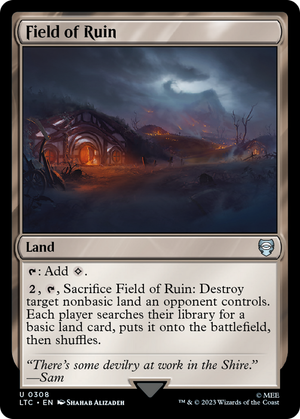
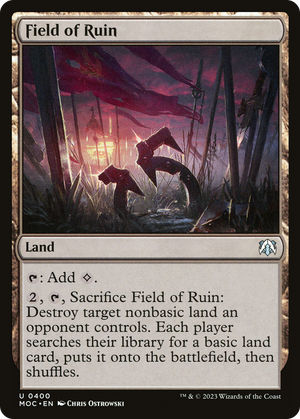
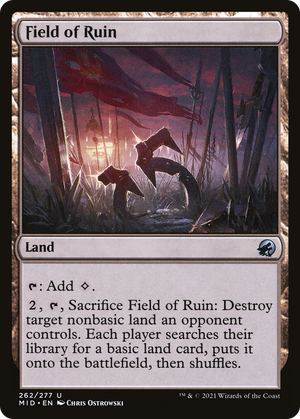
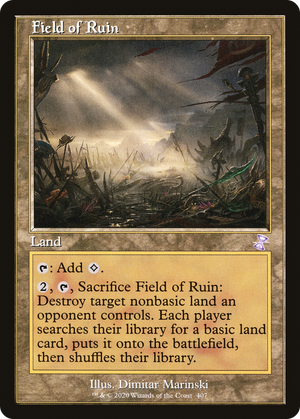
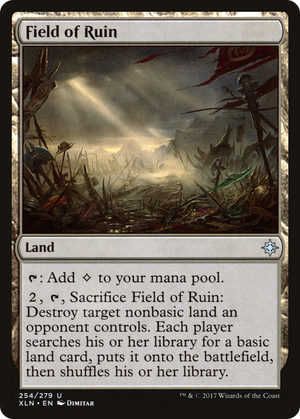
Field of Ruin
Strip Mine and Wasteland taught a generation that nonbasic-land destruction came at a price: a one-shot effect that ate your own land drop, wildly asymmetric, and swingy enough to steal games off a stumbled manabase. This answers a different design question, namely how to give fair decks reliable land hate that polices problem lands without generating the runaway advantage that made its predecessors so punishing. The fetch clause is what softens the blow. When it fires, the targeted opponent loses a nonbasic; then every player, including you and any bystanders, searches for a basic and puts it into play. You sacrifice this land but replace it, breaking even on land count while removing the one nonbasic that mattered: a creature-land, a value engine, a problematic utility source. The opponent breaks even on count too, but trades a customized nonbasic for a vanilla basic, a downgrade rather than a wipe. That symmetry is what lets it run maindeck: you are not stranded a land for using it, taxed only the two generic mana and the land itself. The colorless-only tap is the cost of admission, a deliberate step down from a land that fixes colors, and the reason it slots only into decks that can spare a single source of nothing. It represents a quieter philosophy of interaction than the scorched-earth lands before it: destruction aimed at a specific offender rather than the resource base wholesale, low-variance enough that a format can hold it without a ban hanging over it.
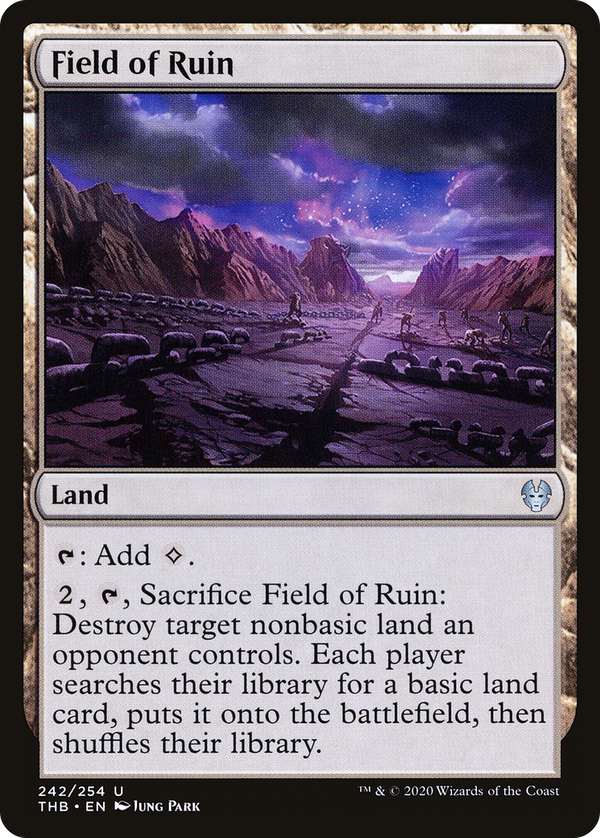
Rules text
 : Add
: Add  .
.
 , , Sacrifice this land: Destroy target nonbasic land an opponent controls. Each player searches their library for a basic land card, puts it onto the battlefield, then shuffles.