Field of Dreams

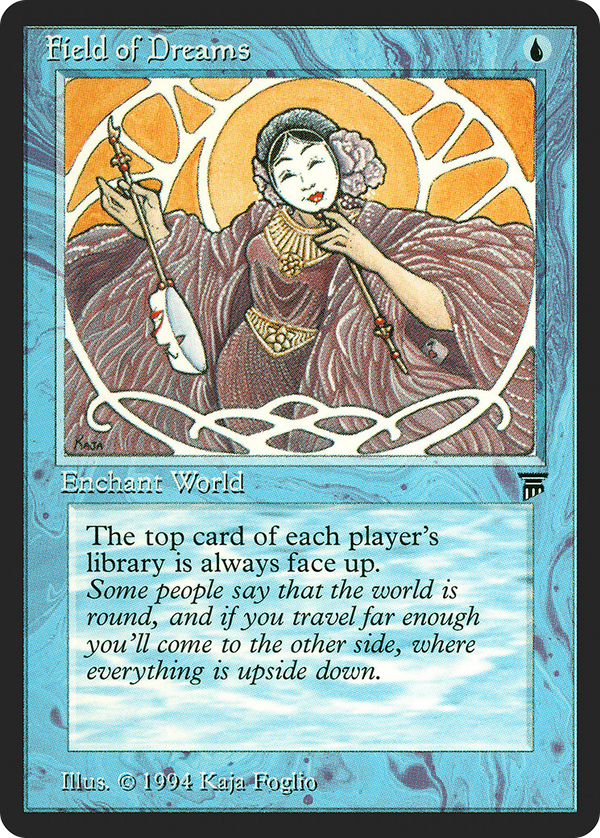
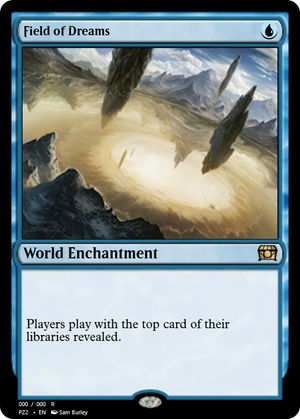
The world enchantment template is what makes this card legible: only one can exist on the battlefield at a time, and the next world enchantment to resolve (cast by either player) replaces it. That mechanic was Wizards' early answer to a question the design team has wrestled with ever since, which is how to put global information-warping effects into the game without letting them stack into incoherent board states. Revealing the top of every library is a smaller version of the same problem Future Sight and Magus of the Future would later solve at higher rates and with single-player scope: shared, symmetric information that rewards the player who built around it. Here the symmetry is total, the cost is a single blue, and the payoff is whatever edge you can wring from knowing both top cards. That tends to favor the deck with more top-of-library manipulation (Brainstorm effects, scry, Sensei's Divining Top) and the deck with cheaper reactive spells, since the defender always knows what is coming. The world supertype itself is largely a dead letter in modern design; cards like this are the reason it existed, and the reason it was quietly retired as a concept worth pushing. What remains is a one-mana curiosity from a period when Magic was still negotiating which kinds of shared-state effects the game could tolerate at all.